




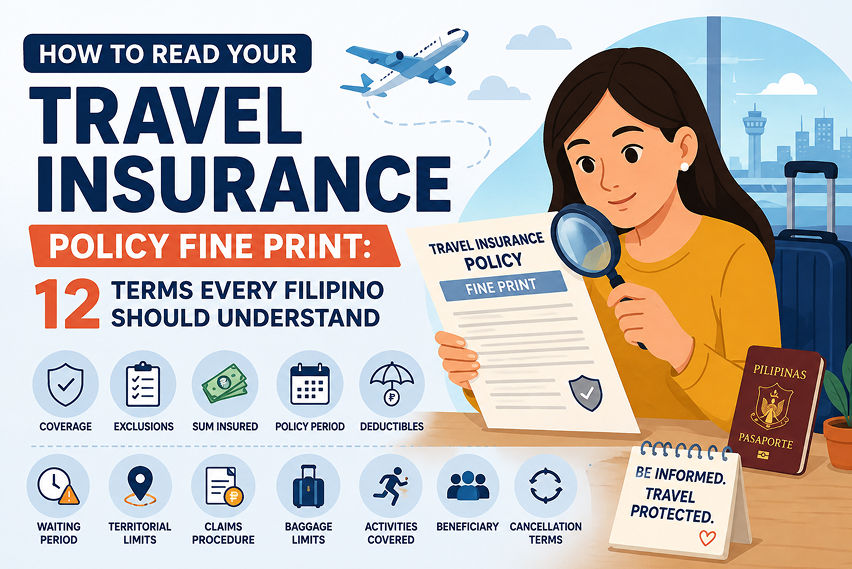
You've booked your flight, picked your hotel, planned your OOTDs for every day of the trip. Then you get to the travel insurance page and... it feels like a different language. Words like "coverage limit," "deductible," and "pre-existing condition" start floating around, and suddenly you just click "I Agree" without really knowing what you agreed to.
Sound familiar? You're not alone. Most Filipino travellers buy travel insurance because it's required for a visa or because the airline suggested it at checkout, not because they actually understand what it covers.
But here's the truth: a travel insurance policy is only useful if you fully understand it before something goes wrong, not after. So let's break down the fine print together, in plain, simple language, the kind you could explain to your younger sibling or your grandparents
Also Read: Travelling with your aged parents? Don’t skip these travel insurance tips!
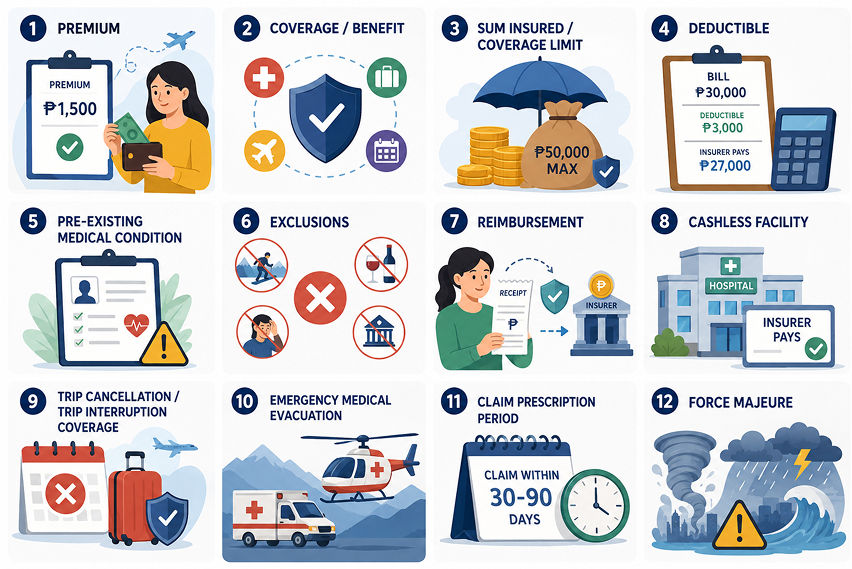
1. Premium
This is simply how much you pay for the insurance policy. Whether it's ₱500 for a 5-day Boracay trip or ₱3,000 for a month in Europe, that payment is your premium. Paying it doesn't guarantee a payout — it just buys you the right to claim if something covered happens to you.
2. Coverage/ Benefit
This is what the insurance promises to pay for—medical expenses, lost luggage, trip cancellation, and so on. Always check the coverage list before assuming your policy covers everything. Some cheap policies only cover a handful of things.
3. Sum insured/ Coverage limit
Sum insured refers to the maximum amount of money the insurance company will pay you for a specific benefit. For example, if your medical coverage has a sum insured of PHP 50,000, that's the cap; even if your hospital bill abroad is PHP 80,000, the insurer won't pay beyond PHP 50,000. The rest is on you.
4. Deductible
This is the amount the insured pays out of pocket before the insurance starts paying.
5. Pre-existing medical condition
This refers to any illness or health condition that you had before buying the insurance policy. It can be asthma, diabetes, or a heart condition. Most standard travel policies do not cover complications from pre-existing conditions unless and until you have specifically declared them and paid extra, or bought a policy that includes this coverage.
6. Exclusions
This is the list of things the policy will NOT pay for, no matter what. Common exclusions include injuries from extreme sports, incidents while drunk, self-inflicted harm, or travelling against government travel advisories. This is arguably the most important section to read — it tells you where you're NOT protected.
 AI-Generated Image
7. Reimbursement
This one is simple. It means you will pay first, then claim the money back from the insurer. Most travel insurance plans work this way nowadays. So, you pay at the hospital or airline upfront, then submit receipts and documents to your insurer for reimbursement.
8. Cashless facility
Some insurers offer this for medical emergencies — meaning the insurer pays the hospital directly, and you don't need to pay out of pocket first. Not all policies offer this, and it usually applies only to partner hospitals, so check whether your insurer has cashless partner facilities at your destination.
9. Trip cancellation/trip interruption coverage
This covers money you lose if your trip is cancelled or cut short for covered reasons, like sudden injury or illness, the death of a family member, or natural disasters. Note that "changed my mind" or "found a cheaper trip" are never covered reasons.
10. Emergency medical evacuation
This covers the cost of transporting you to the nearest proper hospital, or flying you home, if you get seriously injured or sick abroad and local medical facilities can't treat you. This can cost hundreds of thousands of pesos without insurance, so it's one of the most valuable benefits to check.
11. Claim prescription period
This is the deadline for filing your claim after an incident happens —usually 30 to 90 days. Miss this window, and even a valid claim can be denied. Mark your calendar as soon as something happens that you might claim for.
12. Force majeure
This refers to events beyond anyone's control, like natural disasters, wars, pandemics, and government lockdowns. Some benefits (like trip cancellation) may or may not cover force majeure events, so double-check, especially post-pandemic when many travellers learned this term the hard way.
Also Read: Things to check before buying travel insurance: Flights, baggage, & smooth claims
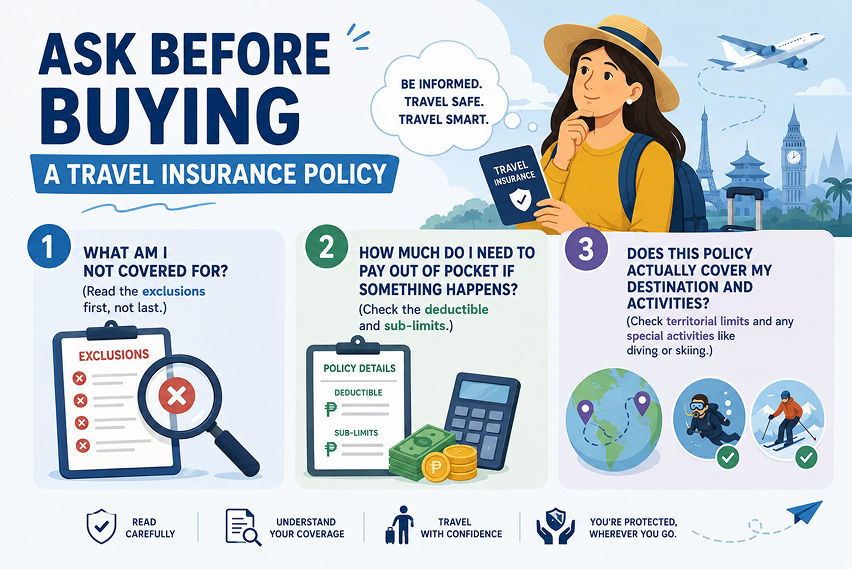
Ask before buying a travel insurance policy
 AI-Generated Image
Before clicking "buy," ask yourself these 3 questions:
- What am I NOT covered for? (Read the exclusions first, not last.)
- How much do I need to pay out of pocket if something happens? (Check the deductible and sub-limits.)
- Does this policy actually cover my destination and activities? (Check territorial limits and any special activities like diving or skiing.)
Also Read: Travelling with your aged parents? Don’t skip these travel insurance tips!
In closing
Travel insurance isn't meant to be complicated — it just sounds complicated because of the jargon. Once you understand terms like sum insured, deductible, exclusions, and territorial limits, reading a policy becomes less intimidating, and choosing the right one becomes easier. The next time you're about to book a trip, don't just glance at the price — take five minutes actually to read what you're buying. That small effort could save you thousands of pesos, or a whole lot of stress, if anything unexpected happens while you're away. Safe travels, and travel smart!
Also Read: Travel insurance vs. airline compensation: Who pays for what?
FAQs
Q1. Is travel insurance mandatory if you are travelling to a foreign country?
Ans. No. The law doesn't require it for all trips, but it is mandatory for Schengen visa applications (Europe) and is required or strongly recommended by several other countries.
Q2. Does travel insurance cover all illnesses that I catch during the trip?
Ans. It all depends on the policy. Many insurers now cover several illnesses, but often with a sub-limit lower than regular medical coverage.
Q3. Can I still buy travel insurance if I already have a pre-existing condition?
Ans. Yes. Just make sure the insurers offer coverage for pre-existing conditions. It is usually available at a higher premium. You must declare it honestly — hiding it can get your entire claim denied, even for something unrelated.
Q4. What happens if I don't use my travel insurance during the trip?
Ans. Nothing happens — you simply don't get anything back. Travel insurance isn't a savings account; it only pays out when something covered actually occurs.
Q5. Should I buy the cheapest travel insurance available?
Ans. Not necessarily. A cheap policy with low sum insured, high sub-limits, and lots of exclusions could leave you underprotected. Compare coverage, not just price, especially for medical evacuation and hospital coverage.
Also Read: Travel insurance for food poisoning abroad: What Filipino travellers should know