




Just imagine a situation where you and your friends booked that long-awaited trip, packed your bags, reached the airport, only to find that the flight has been delayed for six hours, or even worse, it’s been cancelled. In that situation, your first thought will probably be, "Who will help me in this situation?"
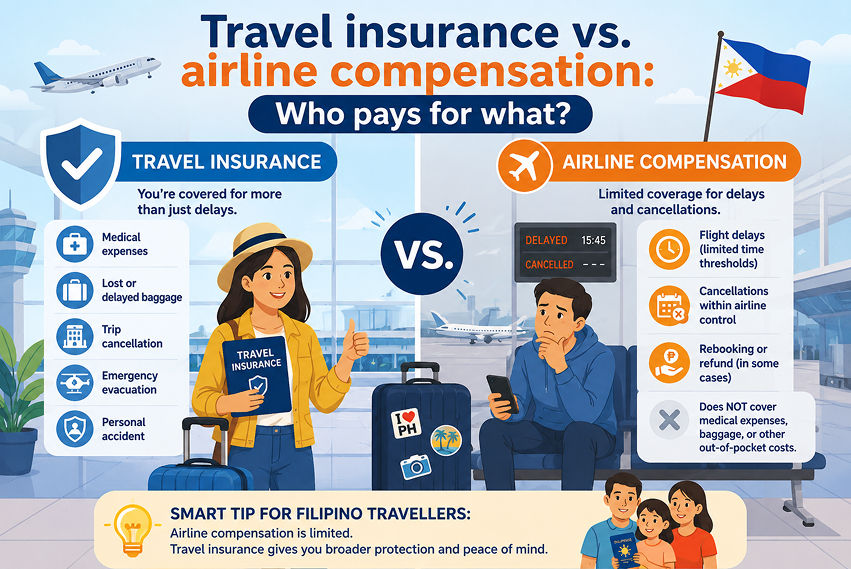
Now, here’s the confusing part: two bodies might help you. First is the airline itself (through Philippine law), and second is your travel insurance policy (that you purchased before the trip). Many Filipino travellers assume they are the same, but they're not. Knowing the difference is essential and could save you thousands of pesos and a lot of stress.
Let's break it down in the simplest way possible.
Also Read: Travelling with your aged parents? Don’t skip these travel insurance tips!
Think of it like two different superheroes
Imagine your trip has two guardians watching over it:
The airline is like a delivery service. Its job is to get you and your bags safely from Point A to Point B. If it messes up that job, say, by cancelling your flight without warning, Philippine law says it owes you certain things.
Travel insurance policy, on the other hand, is like your personal bodyguard that you hired before the trip started. The plan doesn't care who is at fault; it has just one job: to protect you from issues like lost luggage, a medical emergency abroad, a stolen wallet, or even a typhoon that ruins your whole itinerary.
They cover different problems, in different ways, and sometimes both can pay you for the same incident (though not usually for the same expense — more on that below).
Also Read: Things to check before buying travel insurance: Flights, baggage, & smooth claims
What the airline owes you (as per the law)
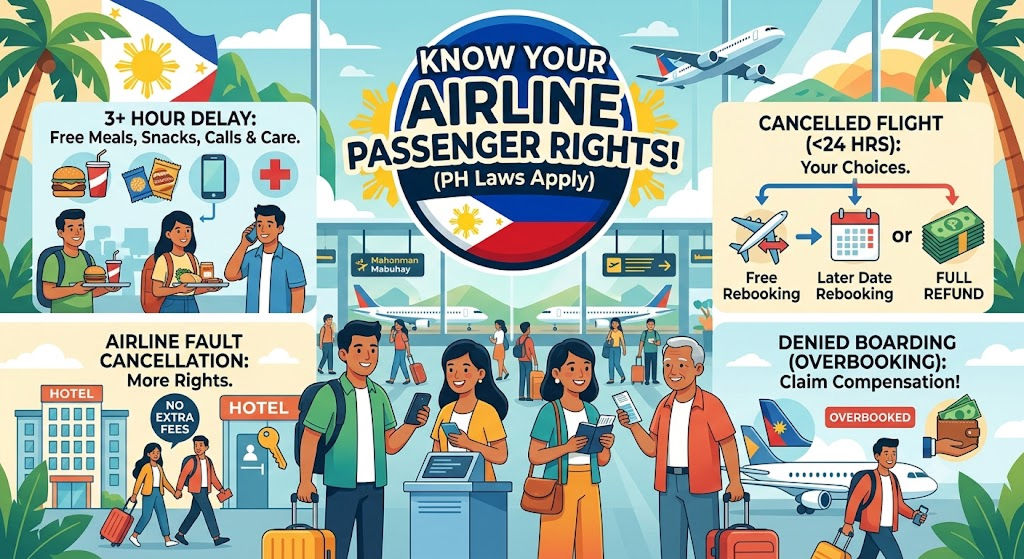
In the Philippines, the Air Passenger Bill of Rights protects travellers and is guided by the Department of Transportation (DOTr) and the Civil Aeronautics Board (CAB).
Here's what you're generally entitled to when the airline is at fault:
 AI-Generated Image
- Delay of 3 hours or more: Free meals, snacks, phone calls, and access to first aid if needed — whether or not it's the airline's fault.
- Flight cancelled with less than 24 hours' notice: You can choose between a free rebooking on the next available flight, a rebooking on a later date, or a full refund.
- Cancellation is the airline's fault: The airline may also need to cover extra costs like hotel accommodation and cannot charge you penalty fees for rebooking or refunds.
- Denied boarding due to overbooking: In this case, travellers may be entitled to compensation for the inconvenience.
Note that if the disruption is caused by things beyond the airline's control, for example, bad weather, natural disasters, security threats, or air traffic congestion. In such cases, the airline usually does not owe you extra compensation.
Also Read: Travel insurance for cruises: Do Filipinos need different coverage?
What does travel insurance cover
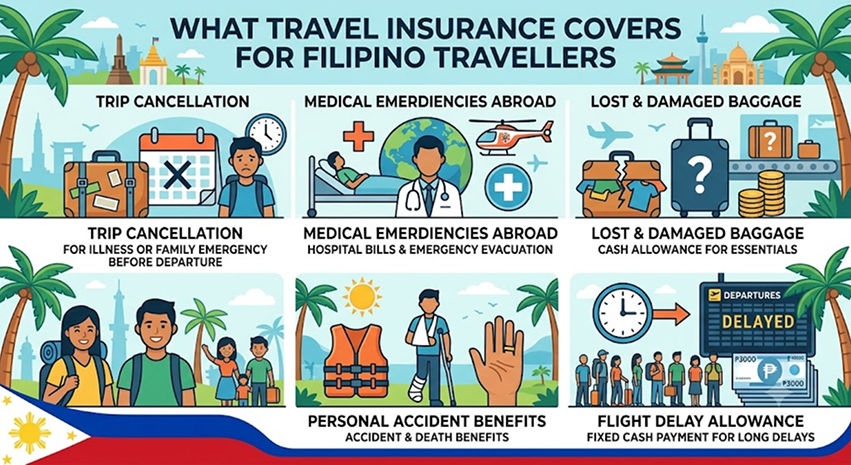
Every traveller needs to understand. Travel insurance fills in the gaps that airline rules don't touch. A decent Filipino travel insurance policy usually covers:
 AI-Generated Image
- Trip cancellation or interruption: if you get sick, a family member passes away, or an unexpected event forces you to cancel before departure.
- Medical emergencies abroad: hospital bills, emergency evacuation, doctor visits (this is often the most valuable part, especially since public healthcare abroad can be extremely costly).
-
Lost, delayed, or damaged baggage: cash allowance to buy essentials while your bags are missing.
Personal accident or death benefits. - Flight delay allowance: some policies pay you a fixed cash amount (like ₱1,000–₱3,000) once your flight is delayed past a certain number of hours, regardless of whose fault it was.
This is the big difference: travel insurance doesn't ask "whose fault was it?" It simply checks, "Did this event happen, and is it in your policy?"
Also Read: Lost laptop, camera & phone abroad: Does travel insurance cover electronics?
Why you shouldn't rely on just one
Many Pinoy travellers think, "The airline will take care of me anyway, why spend extra on insurance?" But airline compensation has limits; it only kicks in for flight-related problems, and only when the airline is clearly at fault. It won't pay your hospital bill in Japan or replace your phone stolen in Vietnam.
On the other hand, travel insurance won't force the airline to rebook you or give you meal vouchers during a delay — that part is still the airline's legal responsibility.
The smartest move? Use both. Know your rights as a passenger, and also get a travel insurance policy suited to your trip, especially for international travel, where medical costs can wipe out your savings in one bad moment.
Also Read: Travel insurance for multi-country trips: One policy or multiple policies?
In closing
Travelling should be exciting, not stressful, but flight problems do happen, even to the most prepared traveller. The key takeaway is this: the airline is responsible for getting you where you're going and helping you when it fails to do so, while travel insurance protects the bigger picture: your health, your belongings, and your peace of mind. Don't leave your trip's safety net to chance. Know your rights under the Air Passenger Bill of Rights, but also invest in a solid travel insurance policy before you fly. That way, whether it's a delayed flight, a lost bag, or a sudden fever in a foreign country, you'll know exactly who to call — and who's going to pay.
Also Read: Travelling during typhoon season: What every Filipino traveller should know about insurance coverage
FAQs
Q1. If my flight is delayed, should I raise a claim with the airline or my insurer?
Ans. Ask the airline for meals, calls, or rebooking on the spot. You can separately check if your insurance policy has "flight delay" benefits; here, you'll usually need your boarding pass and proof of delay to file a claim.
Q2. Does travel insurance cover flight cancellations caused by bad weather?
Ans. Often, yes — this is one of the strongest reasons to get insurance, since airlines typically aren't required to pay extra compensation for weather-related cancellations.
Q3. Can I get compensation from both the airline and my insurance for the same expense?
Ans. Usually no, for the same cost (that's called double recovery, and most policies prohibit it). But you can claim different types of losses from each — for example, the airline covers your rebooking, while insurance covers your missed hotel booking.
Q4. Is travel insurance required for domestic flights as well?
Ans. It's not legally required, but is highly recommended. It comes in handy especially for baggage protection, trip interruption, or unexpected medical needs.
Q5. What documents are required to file an airline compensation claim?
Ans. To file a claim with the airline, you need to keep the following documents: boarding pass, e-ticket, a written notice of delay/cancellation from the airline, and receipts for expenses like meals or hotel stays if you had to pay out of pocket.
Q6. How do I choose a good travel insurance plan?
Ans. It is quite simple: shortlist two to three plans and compare coverage limits, especially for medical and evacuation. Also, check whether flight delay/cancellation benefits are included, read the exclusions, and match the plan to your destination—international trips generally need higher medical coverage than domestic ones.
Also Read: Travel insurance for digital nomads: What Filipinos need to know