




Imagine this, you and your sibling have been counting down the days for your dream trip. You guys saved up for that famous authentic restaurant, scored a cheap promo flight during a midnight seat sale, and packed your favourite clothes. Everything is set!
Then, two days before your flight, you suddenly catch a high fever and get hospitalised with severe dengue. Or worse, you actually make it to your dream destination, but the airline somehow drops your luggage into the abyss, leaving you with nothing but the clothes on your back.
When bad luck strikes during travel, your first line of defence is travel insurance. But let’s be honest, most travellers treat buying insurance like picking candy at a store. We open a comparison website or check the airline add-on tickbox, scroll to the bottom line, find the cheapest option, maybe around PHP 350 to PHP 500, and click buy, then call it a day.
It feels good to save a few hundred pesos, right? Well, until you realise that the cheapest policy only pays out PHP 10,000 for hospital stays, while an emergency room visit overseas easily costs upwards of PHP 150,000.
Price is definitely important (especially with our hard-earned pesos), but picking travel insurance solely based on the price tag is like buying an umbrella made of paper napkins just because it costs PHP 20. Sure, it looks like an umbrella, but the moment it actually rains, you’re going to get soaked.
So, how do you compare travel insurance like a seasoned, smart traveller? Let's break down exactly what you should look for before hitting that "Buy Now" button.
Also Read: Travelling with your aged parents? Don’t skip these travel insurance tips!
1. Don't just look at the total limit, check the sub-limits too
Usually, a massive insurance limit number is the combined maximum for everything. What really matters are the tiny numbers hidden inside called sub-limits.
A sub-limit is the maximum amount the insurance company will pay for a specific problem. Here is a real-world scenario that happens all the time:
The sub-limit trap in action:
- Policy A costs PHP 600 with a PHP 2,000,000 overall coverage limit. However, its sub-limit for emergency medical care is capped at only PHP 50,000.
- Policy B costs PHP 900 with a PHP 1,000,000 overall limit, but its sub-limit for emergency medical care is PHP 500,000.
If you break your leg in Singapore and the medical bill comes to PHP 200,000, Policy A will leave you paying PHP 150,000 out of your own pocket, despite its fancy "2 Million" headline! Policy B, despite being slightly pricier initially, covers the entire bill.
When comparing policies, it is essential to review the individual sub-limits for the events most likely to occur, such as medical emergencies, trip cancellations, and lost baggage.
2. Medical coverage: The single most important clause
 AI-Generated Image
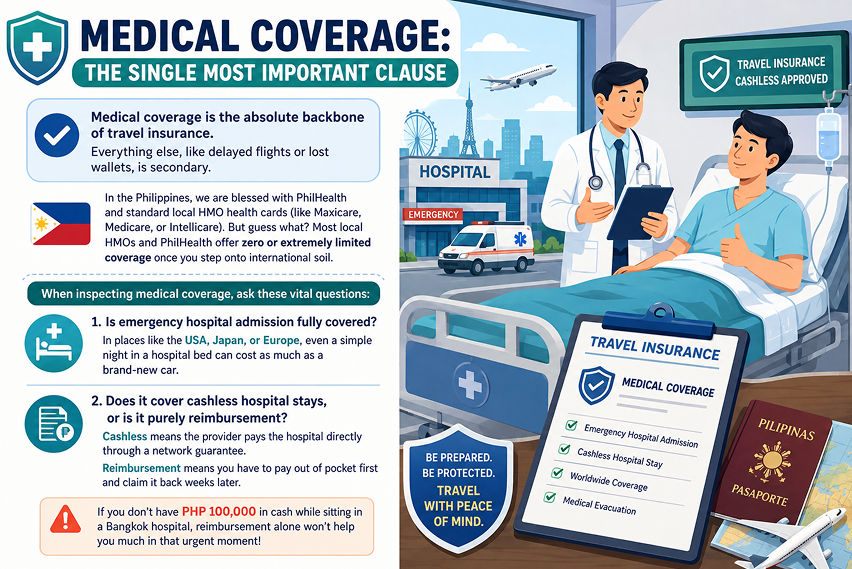
Medical coverage is the absolute backbone of travel insurance. Everything else, like delayed flights or lost wallets, is secondary.
In the Philippines, we are blessed with PhilHealth and standard local HMO health cards (like Maxicare, Medicard, or Intellicare). But guess what? Most local HMOs and PhilHealth offer zero or extremely limited coverage once you step onto international soil.
When inspecting medical coverage, ask these vital questions:
Is emergency hospital admission fully covered? In places like the USA, Japan, or Europe, even a simple night in a hospital bed can cost as much as a brand-new car.
Does it cover cashless hospital stays, or is it purely reimbursement? In insurance, cashless means the provider pays the hospital directly through a network guarantee. Reimbursement, on the other hand, means you have to pay out of pocket first and claim it back weeks later. If you don't have PHP 100,000 in cash while sitting in a Bangkok hospital, reimbursement alone won't help you much in that urgent moment!
Also Read: Medical emergencies abroad (Part 2): How travel protection keeps you safe and covered
3. Medical evacuation vs. repatriation
These two terms sound like complicated medical jargon, but understanding the difference can literally save your life—and your bank account.
- An emergency medical evacuation is the transport of you from where you were injured to the nearest suitable hospital. Suppose you are island hopping in a remote part of El Nido or diving in Raja Ampat, Indonesia, and suffer a decompression injury. You might need a specialised speedboat or air ambulance to reach a major city hospital. That helicopter ride alone can easily cost PHP 500,000 to PHP 1,000,000!
- Repatriation of remains, on the other hand, covers the cost of bringing your body back home to the Philippines if the absolute worst happens. It sounds gloomy, but bringing a deceased loved one across international borders involves intense paperwork, specialised transport, and massive fees that can crush a grieving family financially.
Note: Make sure your travel insurance policy has high limits (ideally at least PHP 1,000,000+) for both evacuation and repatriation.
4. Flight delays, cancellations, and missed connections
Flying in and out of the country often involves schedule changes, typhoons, and technical glitches. This is where travel inconvenience coverage saves your sanity.
However, you need to read the fine print on when the policy starts paying out:
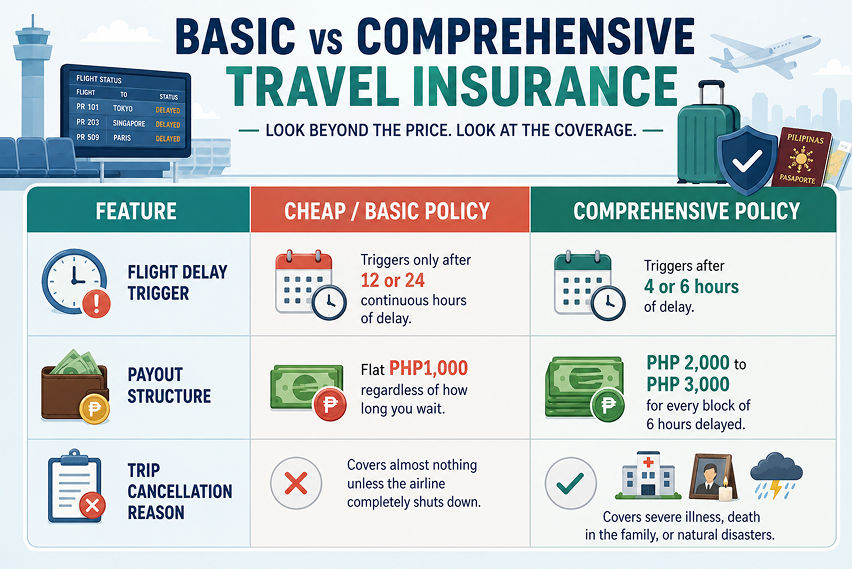
If your flight is delayed by 8 hours and your insurance policy only triggers at 12 hours, you get zero pesos. That’s why checking the hour threshold is far more useful than just looking at the price!
5. Baggage loss vs. baggage delay
Losing your luggage is every traveller's worst nightmare, but there is a big difference between baggage delay and baggage loss:
- Baggage delay gives you an allowance to buy essential items like clothes, a toothbrush, and toiletries if your bag doesn't arrive on the baggage carousel within a certain number of hours (usually 6 to 12).
- Baggage loss compensates you if the airline officially admits it has completely lost your suitcase.
Watch out for per-item limits! Even if a policy advertises PHP 50,000 for lost baggage, it might have a rule saying "Maximum PHP 5,000 per single item." So if you had a PHP 30,000 designer jacket or an expensive camera inside your suitcase, you would only receive PHP 5,000 for it. Always pack your high-value electronics and luxury goods in your hand-carry bag!
Also Read: Things to check before buying travel insurance: Flights, baggage, & smooth claims
6. Adventure sports and activity exclusions
 AI-Generated Image
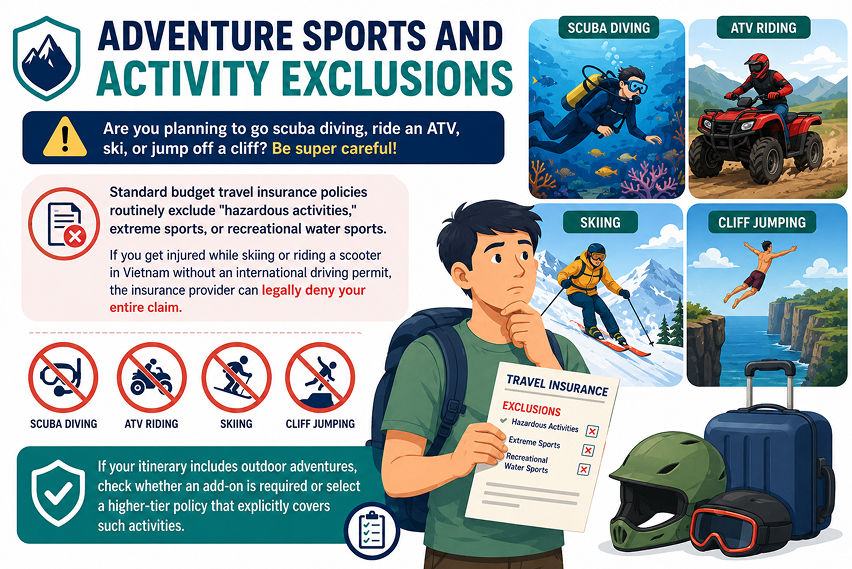
Are you planning to go scuba diving, ride an ATV, ski, or jump off a cliff? Be super careful!
Standard budget travel insurance policies routinely exclude "hazardous activities," extreme sports, or recreational water sports. If you get injured while skiing or riding a scooter in Vietnam without an international driving permit, the insurance provider can legally deny your entire claim.
If your itinerary includes outdoor adventures, check whether an add-on is required or select a higher-tier policy that explicitly covers such activities.
7. The pre-existing medical condition rule
Do you have asthma, hypertension, diabetes, or a heart condition? In the insurance world, these terms are called Pre-Existing Conditions (PECs).
Most standard insurance plans do not cover medical expenses caused by pre-existing conditions. If you have asthma and suffer a sudden, severe asthma attack while walking around Seoul, a regular policy might refuse to pay your hospital bill because you had asthma before buying the policy.
If you or your parents have any existing health condition, look for plans that explicitly offer "Coverage for Pre-Existing Conditions."
8. Claims process and customer assistance
 AI-Generated Image
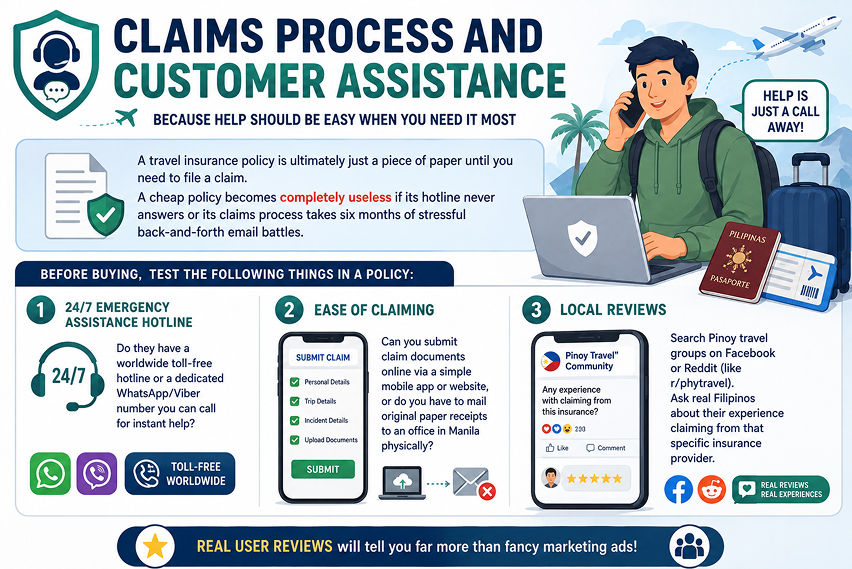
A travel insurance policy is ultimately just a piece of paper until you need to file a claim. A cheap policy becomes completely useless if its hotline never answers or its claims process takes six months of stressful back-and-forth email battles.
Before buying, test the following things in a policy:
- 24/7 emergency assistance hotline: Do they have a worldwide toll-free hotline or a dedicated WhatsApp/Viber number you can call for instant help?
- Ease of claiming: Can you submit claim documents online via a simple mobile app or website, or do you have to mail original paper receipts to an office in Manila physically?
- Local reviews: Search Pinoy travel groups on Facebook or Reddit (like r/phytravel). Ask real Filipinos about their experience with that specific insurance provider when making a claim. Real user reviews will tell you far more than fancy marketing ads!
Summary: Quick comparison checklist for Pinoy travellers
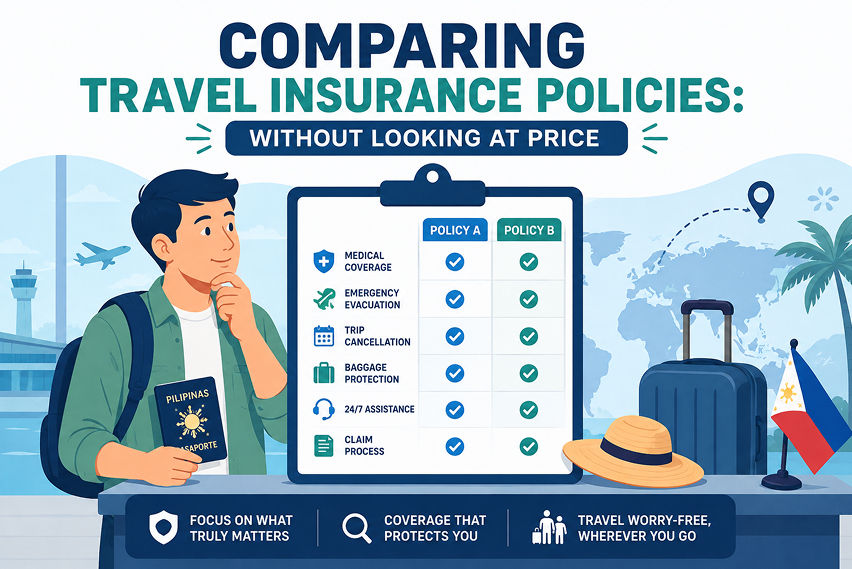
To make your decision easy, here is a quick cheat sheet to use next time you compare policies. The medical sub-limit is high enough for the destination you plan to travel to (e.g., PHP 2M for countries like Japan, the USA, and Europe).
- Emergency medical evacuation and repatriation limits
- Flight delay trigger hours
- Baggage delay vs. loss rules
- Adventure sports or special activities coverage
Final thoughts: Invest in peace of mind
At the end of the day, travel insurance isn't about expecting the worst to happen—it's about making sure that if something does go wrong, your dream vacation doesn't turn into a financial nightmare that wipes out your hard-earned savings.
So, the next time you prepare for a trip, take an extra five to ten minutes to look beyond the lowest price plan. Instead, compare the following: - medical sub-limits, flight delay hours, and evacuation coverage, then choose a reliable provider.
Remember, a few extra pesos today can save you hundreds of thousands of pesos tomorrow.
Also Read: The biggest travel insurance claim mistakes Filipino travellers make & how to avoid them
FAQs
Q1. Is travel insurance required for Filipinos travelling abroad?
Ans. It depends on your destination! For Schengen countries in Europe, travel insurance with a minimum medical coverage of €30,000 is strictly mandatory for visa approval. For countries like Japan, Singapore, or Thailand, it may not be legally required upon entry, but it is highly recommended to protect yourself from unexpected bankruptcy costs.
Q2. Can I just rely on the free travel insurance provided by my credit card?
Ans. Credit card travel insurance is a great perk, but always check the conditions! Usually, it applies only if you paid 100% of your round-trip flight tickets with that specific credit card. Furthermore, free credit card policies often have very low medical sub-limits and strict requirements. Always read the policy certificate before relying on it completely.
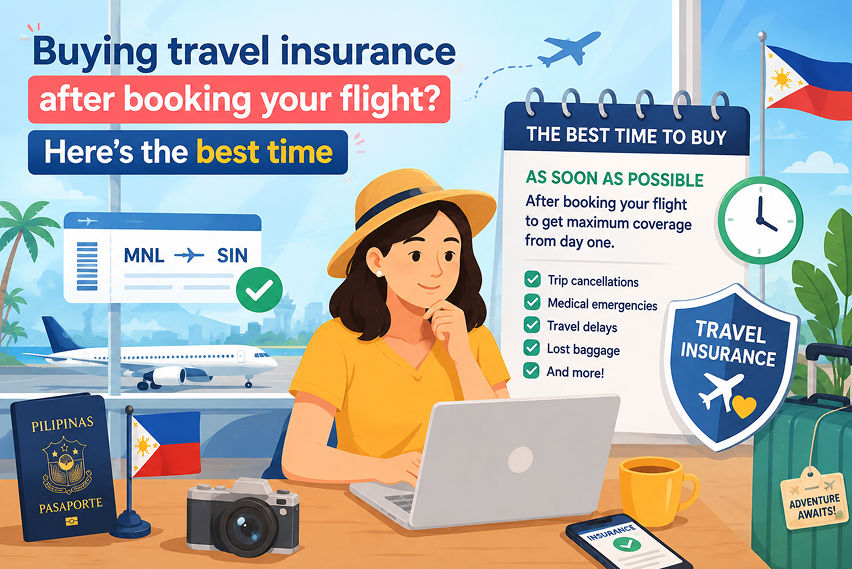
Q3. When is the best time to buy travel insurance?
Ans. Buy it as soon as you book your flights and hotels! If you buy insurance months ahead of your trip, you are immediately covered for pre-trip cancellations (for example, if you get hospitalised before your travel date or if a major typhoon forces flight cancellations). Waiting until the night before your flight leaves you unprotected during the planning window.
Q4. What is the difference between individual and annual multi-trip travel insurance?
Ans. An individual (single-trip) policy covers a specific trip with fixed start and end dates. An annual multi-trip policy covers all international trips you take within 365 days (usually up to 30 or 90 days per trip). If you travel abroad 3 or more times a year, getting an annual policy is almost always cheaper and much more convenient!
Q5. Will my local HMO (Maxicare, Medicard, etc.) cover me overseas?
Ans. Generally, no. Most local HMOs operate only within their networks of accredited hospitals in the Philippines. Some premium executive plans offer minor emergency riders abroad, but they are rarely enough to cover major hospitalisations overseas. Travel insurance fills this massive gap.
Q6. How to make a medical claim while travelling?
Ans. First and foremost, contact your insurer’s 24/7 emergency hotline number (before or right after receiving treatment). Next, make sure to keep every single paper document, including medical records, doctor's diagnosis notes, official receipts, pharmacy receipts, and hospital discharge summaries.
Also Read: Travel insurance checklist for first-time Filipino travellers