




You have saved up for months, packed your bags, and secured your visa. Your flights are booked, and your itinerary is packed with food trips and sightseeing. But when an emergency strikes miles away from home, will your travel insurance actually pay out?
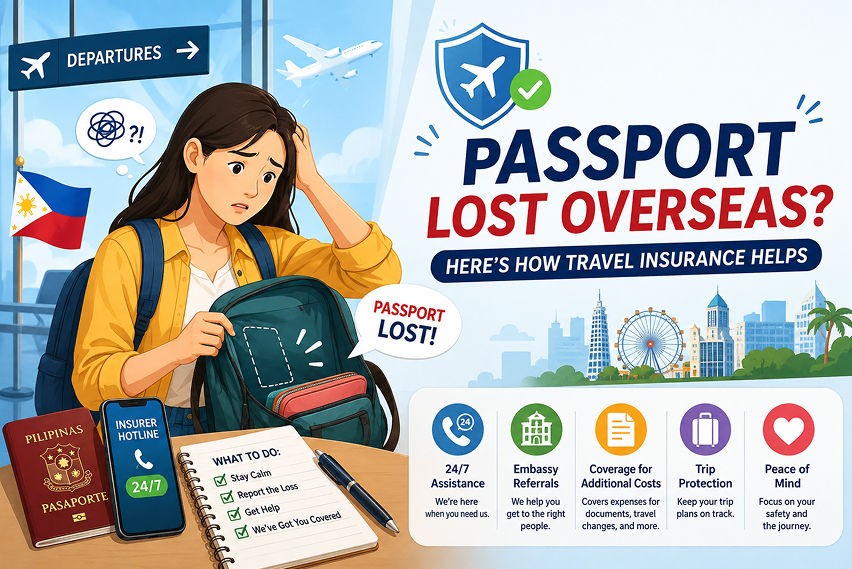
For instance, you are standing in the middle of a sightseeing trip, surrounded by other travellers. Your stomach suddenly drops. Not because of the famous local dish you just ate, but because you realise your passport and wallet are nowhere to be found. Or maybe you are lying in a hospital bed with a high fever, staring at a medical bill written in a language you cannot read, totalling thousands of dollars.
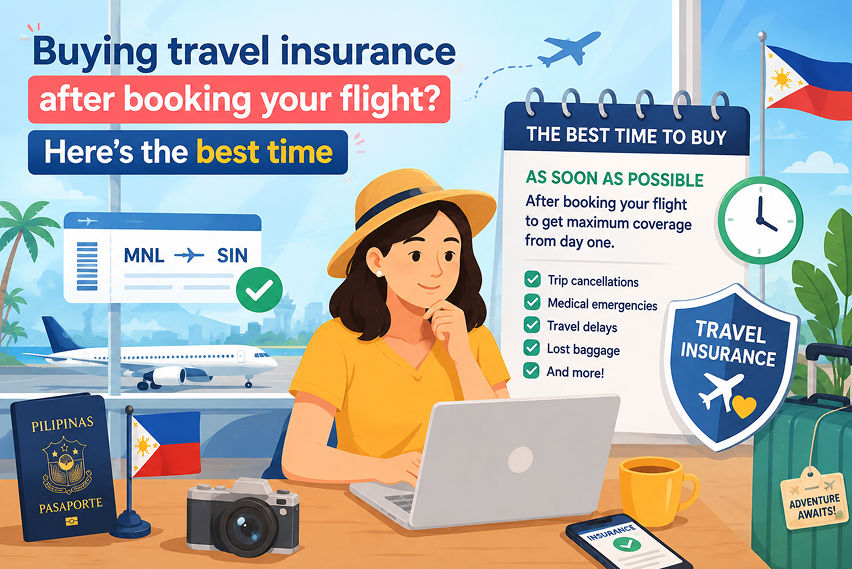
In moments like these, your travel insurance is supposed to be your ultimate safety net. It is the invisible shield that protects your hard-earned savings from turning into a financial nightmare. But here is the hard truth that many Pinoy travellers learn the painful way: buying a policy is only half the battle. Getting the insurance company to actually pay your claim is where the real challenge begins.
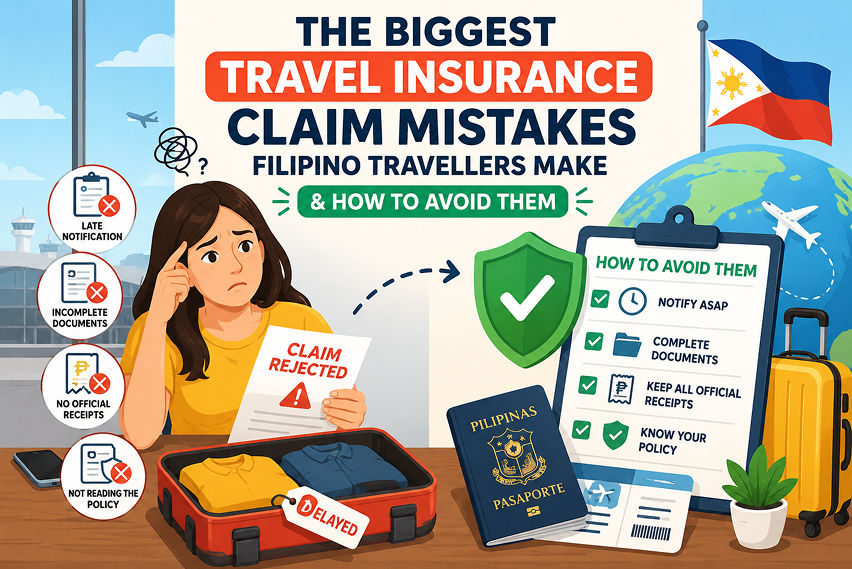
Every single year, thousands of Filipino travellers have their insurance claims delayed, rejected, or outright denied. Why? Not because insurance companies are evil, but because travellers make tiny, avoidable mistakes during the process. Let us walk through the biggest travel insurance mistakes Filipinos make and, more importantly, how you can avoid them so you never lose your hard-earned money.
Also Read: Travelling with your aged parents? Don’t skip these travel insurance tips!
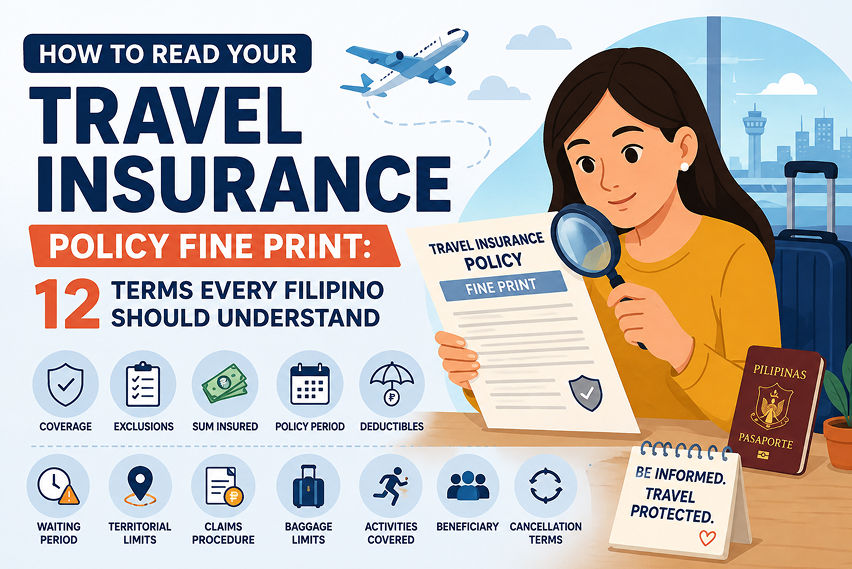
1. Buying without reading the fine print
 AI-Generated Image
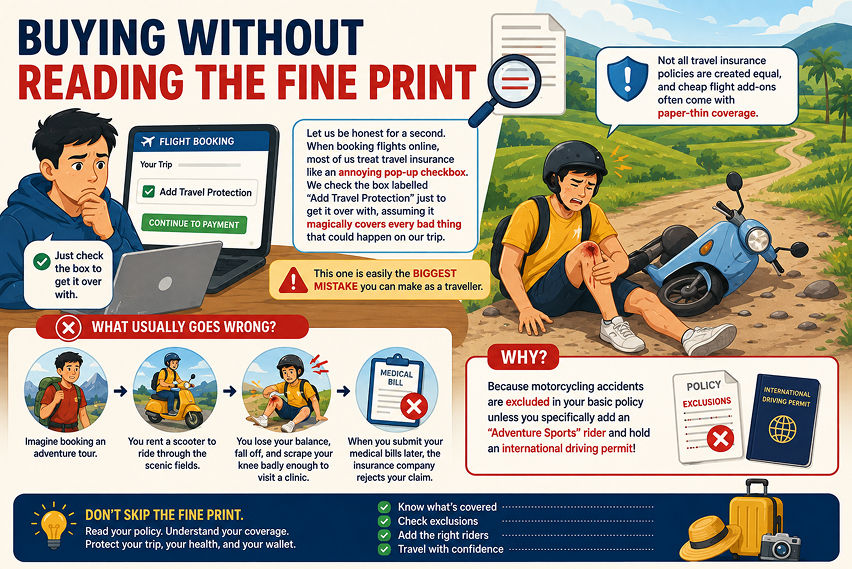
Let us be honest for a second. When booking flights online, most of us treat travel insurance like an annoying pop-up checkbox. We check the box labelled "Add Travel Protection" just to get it over with, assuming it magically covers every bad thing that could happen on our trip.
This one is easily the biggest mistake you can make as a traveller. You see, not all travel insurance policies are created equal, and cheap flight add-ons often come with paper-thin coverage.
Also Read: How to claim travel insurance: A step-by-step guide for Pinoy travellers
What usually goes wrong?
Imagine booking an adventure tour. There, you rent a scooter to ride through the scenic fields. You lose your balance, fall off, and scrape your knee badly enough to visit a clinic. When you submit your medical bills later, the insurance company rejects your claim. Why? Because motorcycling accidents are excluded in your basic policy unless you specifically add an "Adventure Sports" rider and hold an international driving permit!
How to avoid it: Never buy blind. Spend ten minutes reading the Policy Wording or Exclusions Page. It is recommended to look specifically for coverage limits on medical expenses, lost baggage, flight delays, and emergency evacuation. If you plan to be adventurous on your trip, such as riding a bike, hiking high mountains, or scuba diving, check whether your policy explicitly covers those activities.
Also Read: Medical emergencies abroad (Part 2): How travel protection keeps you safe and covered
2. Waiting too long to report the incident
 AI-Generated Image
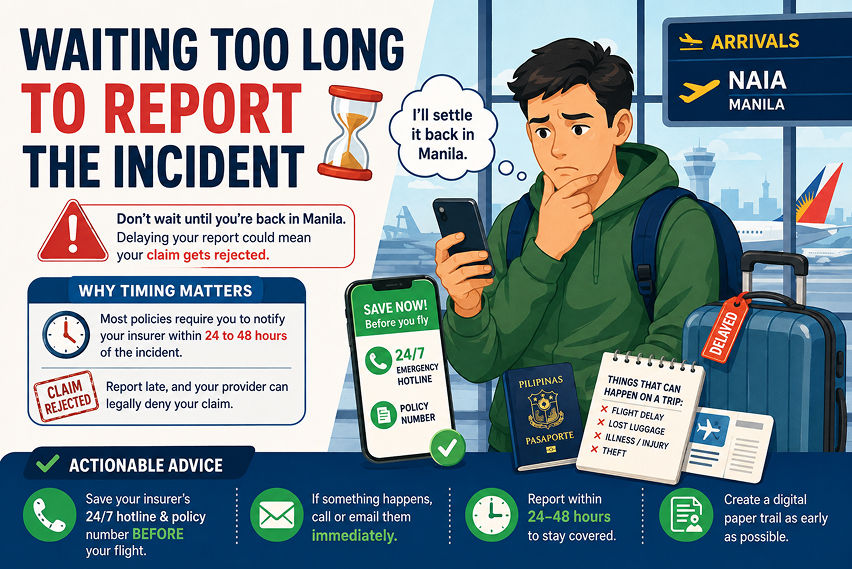
Filipinos are famously polite and patient. When something goes wrong on a trip, like delayed luggage or a minor injury, our first instinct is often: "Let it be for now, we are heading home soon anyway. I will settle it back in Manila.”
Waiting until you touch down at NAIA to start your claim is a guaranteed recipe for rejection.
Why timing matters so much
Insurance contracts contain strict deadlines. Most policies require travellers to notify them within 24 to 48 hours of an incident occurring. For example, if your bag is stolen and you wait five days before returning to Quezon City to report it, your provider can legally deny your claim for missing the mandatory reporting window.
Actionable Advice: Save your insurance company's emergency 24/7 hotline number and policy number on your phone BEFORE you board your flight. If your flight is delayed by more than 6 hours, if you get sick, or if your items are stolen, call or email them immediately. Stamp a digital paper trail as soon as humanly possible.
Also Read: Things to check before buying travel insurance: Flights, baggage, & smooth claims
3. Leaving the police or airline counter without official papers
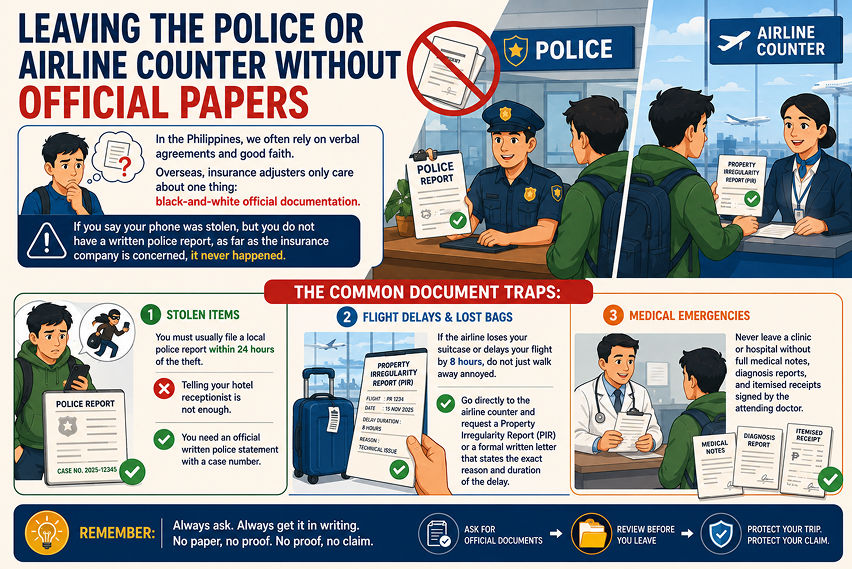
In the Philippines, we often rely on verbal agreements and good faith. Overseas, insurance adjusters only care about one thing: black-and-white official documentation. If you say your phone was stolen, but you do not have a written police report, as far as the insurance company is concerned, it never happened.
4. Keeping raw receipts instead of digital backups
 AI-Generated Image
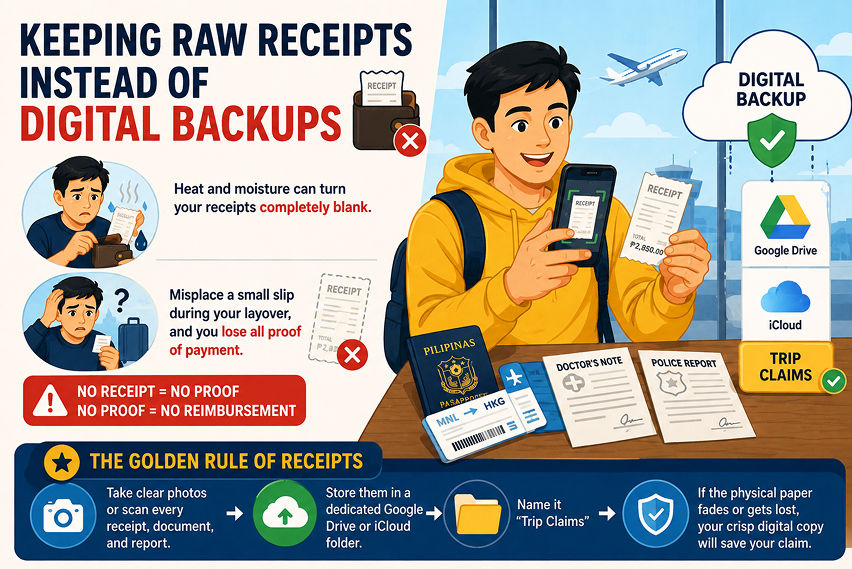
You survived a medical emergency, collected all your pharmacy paper receipts, and kept them neatly in your wallet. Two weeks later, when you sit down to file your claim, you open your wallet only to find that the heat and moisture have turned your receipts completely blank!
Or worse, you misplace that small slip of paper during your layover. No receipt is a clear indication of no proof of payment, which will lead to zero reimbursement.
The golden rule of receipts: Take clear photos or scan every single receipt, doctor's note, boarding pass, and police report the exact second you receive it. Store them in a dedicated Google Drive or iCloud folder named "Trip Claims". If the physical paper fades or gets lost, your crisp digital copy will save your claim.
Also Read: Things to check before buying travel insurance: The ultimate checklist (Part 1 Health & Safety)
5. Concealing pre-existing medical conditions
When filling out insurance forms, nobody likes answering "Yes" to questions about health conditions, especially if it raises the premium price by a few hundred pesos. Many Pinoy travellers think, "My high blood pressure is controlled anyway, I won't write it down to save money.”
This is called non-disclosure, and it is the fastest way to get your policy completely voided.
Also Read: Planning your next trip? Here is how AXA Smart Traveller keeps you covered
How insurers catch you
If you get hospitalised abroad for a heart issue or severe dizziness, insurance investigators will request access to your medical history back home. If they discover you have been taking blood pressure medication for three years but checked "No" on your application, they will reject your entire claim, even if the hospital bill is over PHP 1,000,000!
What to do: It is highly recommended to declare any pre-existing conditions (such as asthma, diabetes, or hypertension). Yes, doing so might cost more or require a special add-on coverage, but it will ensure your insurance policy covers you when you need it most.
Also Read: 7 Questions to ask before buying travel insurance
6. Assuming alcohol-related mishaps are covered
 AI-Generated Image
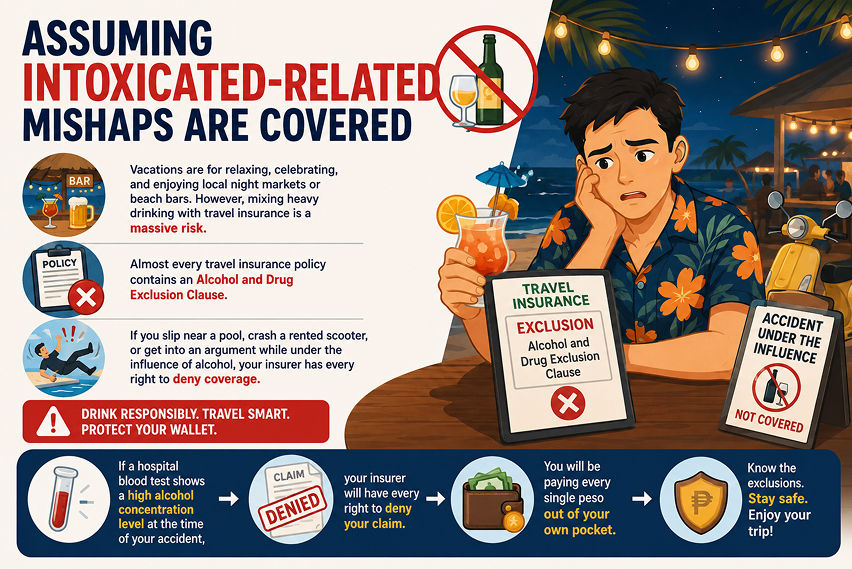
Vacations are for relaxing, celebrating, and enjoying local night markets or beach bars. However, mixing heavy drinking with travel insurance is a massive risk.
Almost every travel insurance policy in the world contains an Alcohol and Drug Exclusion Clause. If you slip near a pool, crash a rented scooter, or get into an argument while under the influence of alcohol, your insurer has every right to deny coverage. If a hospital blood test shows a high alcohol concentration level at the time of your accident, you will be paying every single peso out of your own pocket.
Quick checklist: How to guarantee a smooth insurance claim
Keep this handy checklist on your phone whenever you travel overseas:
- Before flying out: Make sure to read the policy exclusions. Next up, save the 24/7 emergency helpline number, and get digital copies of your policy to a family member back home.
- During an incident: Try to notify the insurer within 24 hours. Also, request an official written report (Police Report, PIR, or Doctor's Diagnosis) immediately.
- Before leaving the spot, take clear, multiple photos of damaged items, doctor certificates, and all official receipts.
- Filing the claim: Submit all organised files, original receipts, and filled-out forms within 30 days of returning to the Philippines.
Also Read: Traveller's blueprint: How and when travel insurance pays for emergencies
Final Thoughts: Travel Smart, Travel Safe
Travel insurance is not just another expense on your trip budget—it is your peace of mind. Nobody plans to get sick, lose a passport, or miss a flight, but these things happen to even the most experienced travellers. By avoiding the above-mentioned mistakes, keeping your receipts organised, and securing proper documentation & reports, you can explore the world with total confidence knowing you are truly protected. Safe travels.
Also Read: Travel Master vs. TraveLite: Which Malayan plan is right for your next trip?
FAQs
Q1. Can I buy travel insurance after I have already left the Philippines?
Ans. Most standard Philippine insurers require you to buy the policy before departing the country. However, some specialised international providers allow purchase after departure, though a waiting period (usually 3 to 7 days) will apply before coverage kicks in.
Q2. What should I do if my flight gets delayed for hours?
Ans. First and foremost, do not panic and visit the airline desk. Ask for a written certificate stating the reason and duration of the flight delay. Keep all receipts for food, drinks, or hotel stays you paid for while waiting, as you can claim these under travel inconvenience coverage.
Q3. Is free travel insurance from my credit card good enough?
Ans. Credit card insurance is a great perk, but it often has strict conditions—like requiring you to pay 100% of the flight tickets using that specific card. Always check the coverage limits, as free policies usually offer lower medical coverage than standalone plans.
Q4. How long does it usually take to receive my claim payout?
Ans. If all your documents, receipts, and reports are complete, payouts generally take between 14 and 30 business days. Missing documents will cause a significant delay; to submit everything in a single complete package.
Q5. Will my travel insurance policy pay for my hospital bills upfront?
Ans. For major hospitalisations, most insurers can arrange direct billing with the hospital through their emergency assistance partner. For minor clinic visits or medication, on the other hand, you will usually need to pay cash upfront and file for reimbursement later.
Q6. What happens if I lose my belongings due to my own carelessness?
Ans. Insurance covers theft and accidental loss, but it does NOT cover negligence. If you leave your wallet unattended on a restaurant table while getting food and it gets stolen, the claim will likely be rejected for lack of reasonable care.
Also Read: Oona Philippines travel insurance: Everything you need to know before you buy