




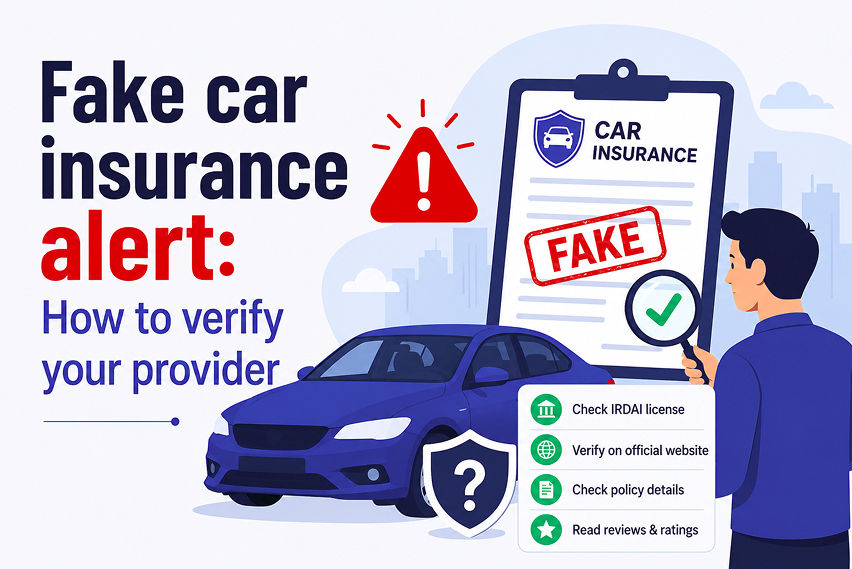
There is no shortage of fake insurance providers, and their target usually includes first-time owners, busy professionals who prefer online transactions, drivers looking for cheap premium deals, and OFWs buying insurance for their family car back home.
Scammers promote fake policies via social media platforms and messaging apps. They often copy logos and branding from legitimate providers to look convincing to clients.
Note that fake insurance policies may look real at first glance; victims usually discover the scam when they file a claim.
Let us learn more about fake car insurance and how to verify a provider's legitimacy in the following sections.
Common signs of a fake car insurance policy
Spotting warning signs early helps you avoid fake insurers and their policy scam. Here are some common red flags -
Unrealistically low premium
If the insurance cost is dramatically lower than the competitors', you need to watch out. Scammers often use taglines like "no document needed," "instant approval," and "50% cheaper insurance" to attract clients.
While discounts are common across the insurance sector, extremely low premiums are not. So, do proper checks.
No official documents
A legitimate provider often provides clients with official receipts, policy terms & conditions, and contact details. Note that if the seller avoids paperwork or sends blurry screenshots, it could be a red flag.
Poor online presence
Fake insurance companies have a poor online presence, which may manifest as newly created social media accounts (Facebook, Instagram, TikTok), a lack of an official website, and a heavy reliance on copied images.
Suspicious payment method
Scamsters are characterised by suspicious payment methods, such as requests to send money to personal accounts or to pay via an unverified e-wallet. For legitimate providers, payments are accepted through official gateways.
Also Read: Got a new high-end car? Here is the best insurance guide (for 2026)
Step-by-step process to verify an insurance provider
Every car owner needs to follow this checklist before buying an insurance policy. Doing so will ensure that you partner with a genuine provider that stands by your side when needed.
Here’s the step-by-step verification process -
Step 1. Check the provider’s Insurance Commission’s accreditation. This will help confirm its legitimacy.
Step 2. Verify the agent’s authenticity; check their licence and avoid fake representation.
Step 3. Request official quotations; this would ensure professionalism on the part of the provider.
Step 4. Confirm payment channels to help protect your finances.
Step 5. Read customer reviews. Doing so would show you the actual picture and reveal scam patterns, if any.
Step 6. Review policy coverage. This would help you avoid the insurer’s fake promises.
Step 7. Ask for official receipts from the insurer. This will give legitimacy to the partnership.
Do not freak out, following the above-mentioned steps only takes a few minutes, but saves thousands of pesos.
A few details/information that’ll ease the verification process
- Visit the Insurance Commission’s official website, and while you're at it, check accredited companies and verify licensed agents.
- Confirm the provider’s registration by asking for company IDs. business registration number, and agent license details.
- Verify insurer’s customer reviews at Google, Facebook, and online forums.
- Call the provider’s official hotline number listed on the official website.
Also Read: The Philippines Insurance Commission: Ways in which it protects car owners
Fake insurance policy: Risks involved
 AI-Generated Image
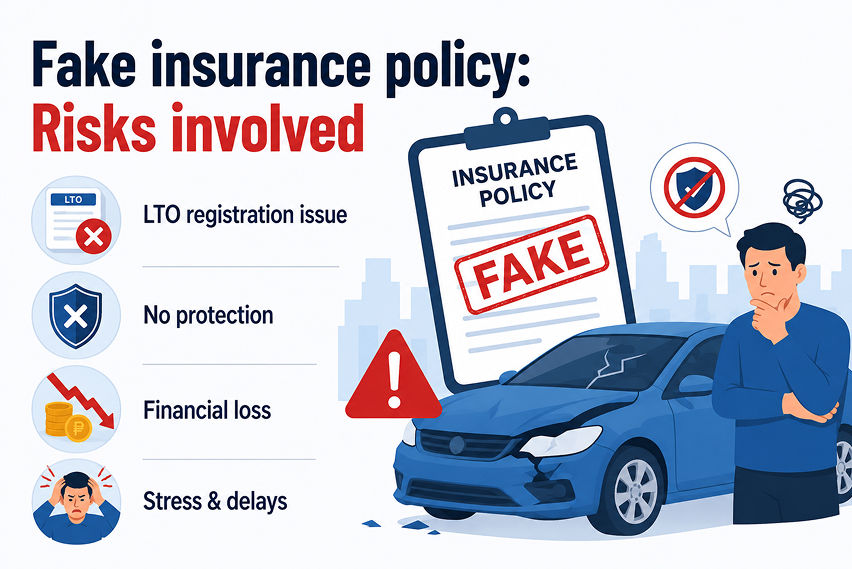
Having a fake insurance policy in hand is quite risky and can lead to financial & legal troubles. Here are the risks involved-
LTO registration issue: If your CTPL insurance is invalid, your vehicle’s LTO registration will get compromised. This will require immediate action and rectification, as it is illegal to drive a motor vehicle with LTO registration.
No protection: Fake insurance means fake coverage - no protection from damages like accidents, fire, theft, etc. This will put you both under financial and mental stress in the event of an accident or other unfortunate event. Meaning no repair or replacement coverage, rejection of theft claim, and the burden of medical expenses.
Financial loss: Victims of a fake policy often incur the following financial losses, including lost premium payments, legal assistance costs, and additional costs incurred with a legitimate insurer.
Stress & delays: Scam victims often experience stress during events like accidents. It may be due to delayed claims or difficulty in contacting the agent, etc.
You got scammed? Here’s what to do
The moment you suspect a fake insurance policy or provider, here’s what you need to do with immediate effect -
Step 1. Stay calm and make an action plan.
Step 2. Stop all payments with immediate effect, so additional money should not be transferred.
Step 3. Start gathering evidence. Collect receipts, screenshots, emails, conversations, and policy documents.
Step 4. Inform the authorities asap. Start by reporting the scam to the Insurance Commission.
Step 5. Contact your bank; request that they initiate a transaction reversal. Also, ask for fraud assistance.
Step 6. Get legitimate coverage; what’s done is done, but now you need genuine protection for your car and your finances.
Also Read: When your car insurance won’t help you - even if you paid on time!
How to avoid insurance fraud?
Wanna stay protected from insurance scams that can get you into deep trouble and losses? Here’s what you need to do -
Tip 1. Avoid rush transactions
Remember, scammers are quite persuasive and often use phrases like “limited-time offers, " "pay now or lose the discount”, etc. If you come across such terms, take your time and verify the details thoroughly.
Tip 2. Buy directly from the official sources
Make sure to use the official website, visit an authorised branch, and communicate with a verified agent. All these are official channels, where you won't find a scammer.
Tip 3. Keep all the important documents handy, along with a photocopy
Always save copies of documents you receive or exchange during the course of transaction with the insurer. This includes receipts, policy contracts, email confirmations, and related documents. Why? If anything goes wrong, they will serve as evidence.
Tip 4. Protect your personal information
Do not send/share your personal information, like IDs, vehicle documents, or bank details, with unverified providers, agents, or individuals. Doing so can lead to identity theft.
Also Read: Personal Accident Coverage for riders in the Philippines: Why it matters
Buying insurance online: Recommended practices to follow
 AI-Generated Image
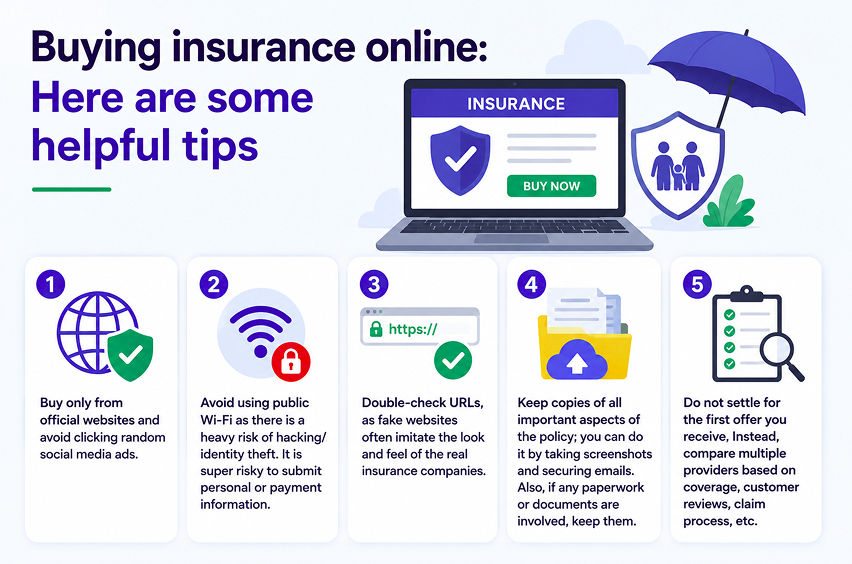
Buying car insurance is important, and doing it online is convenient. However, to make the process safe and effort count, follow these practices.
Practice 1. Only go to secure websites
Whenever buying or making a payment online, make sure the website you are using is secure. This can be done by looking for signs of genuineness, such as HTTPS security, an official domain, and a verified company page.
Practice 2. Compare quotes from multiple providers
Be it offline or online, buying the best insurance deal requires you to compare at least two to three quotes. While doing so, make sure to compare apples with apples (policies with the same coverage & benefits) and avoid selecting the cheapest plan available. Compare providers based on coverage, reputation, customer service, and claim process.
Practice 3. Understand the policy
It is important to read and understand the policy thoroughly. While at it, look at the policy exclusions, deductibles, coverage limits, and claim requirements.
Also Read: Is your current insurance provider still worth it in 2026? Here’s how to tell
Bottom line
Scams are common these days, especially with digitisation, which makes it even harder to distinguish genuine from fraudulent practices. The insurance world has its share of scams, and you can end up being a policyholder with a company that never existed!
What to do to stay protected? Staying informed is the way to protect yourself from being a victim. A few good practices to follow include verifying the provider, confirming agents' credentials, and avoiding deals that are too good to be true.
Remember, a few extra minutes of cross-checking can save you from financial, legal, and mental stress in the future. So, if you are out there to renew your policy or buy a new one, make sure to go with a well-reputed, IC-certified provider that provides real protection for your car, passengers, and yourself.
Also Read: Must-have add-ons for 2026: What you shouldn’t miss
FAQs
Q1. Why is a comprehensive plan important for car owners?
Ans. A comprehensive insurance plan offers broader protection than CTPL for car owners. It offers coverage for theft, accidents, vehicle damage, and fire.
Q2. Does a fake insurance policy affect the vehicle’s LTO registration?
Ans. Yes absolutely. An invalid CTPL insurance plan can lead to registration rejection.
Q3. What to do if I have already paid a premium for a plan from a fake provider?
Ans. It is a sensitive case; don’t panic, stay calm and do the following: gather evidence, report the scam to the authorities & IC, and contact your bank for assistance.
Q4. Is buying car insurance online safe?
Ans. Yes, absolutely. However, while doing so, make sure to verify the authenticity of the provider and website.
Q5. How to verify the authenticity of an insurance provider?
Ans. It’s quite simple. All you have to do is go to the Insurance Commission website and check the provider’s name in the accredited insurer’s list.
Q6. What is the biggest red flag that shouts fake insurance policy?
Ans. Here are some red flags to look out for: highly attractive offers (low price, high coverage), poor customer reviews, and personal payment accounts.
Also Read: Is SRCC add-on car insurance worth it for Filipino car owners in 2026?