




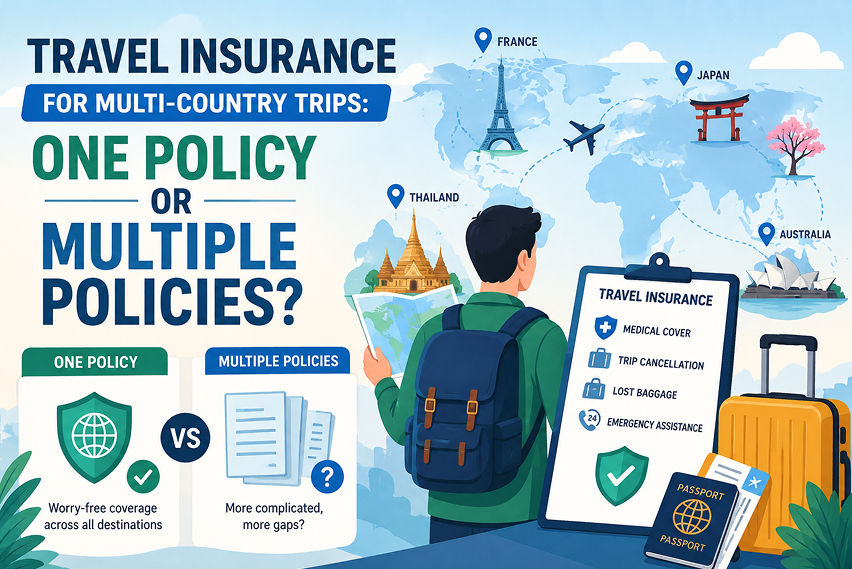
You’ve been saving your hard-earned money for months. Your leave form at work is finally approved. You’re standing at the airport, passport in hand, iced coffee in the other, ready to board a flight. But you do not have just one stop! In two days, you’ll be hopping on to another destination, and after that, another short flight to the final destination.
Awesome, right? Absolutely. Multi-country trips are the ultimate dream for Pinoy travellers who want to pack as much adventure as possible into a single vacation. But amidst all the excitement of packing your favourite outfits, plotting your Instagram grid, and downloading offline maps, one vital question pops up right when you’re about to book protection for your journey:
Should you buy one travel insurance policy that covers all your destinations, or should you buy separate policies for each country on your itinerary?
It sounds like a tricky financial headache, but don't worry! In this guide, we will break everything down. So, by the end of this read, you’ll know the exact step-by-step strategy to keep your wallet safe and your trip completely stress-free.
Also Read: Medical emergencies abroad: How travel protection keeps you safe and covered
What does "multi-country travel insurance" actually mean?
Before jumping into comparing your options, let’s get clear on what travel insurance actually does when you cross international borders.
Think of travel insurance as an invisible safety helmet for your vacation. If you slide on wet pavement and scrape your knee, if your luggage gets lost somewhere along the way, or if a sudden typhoon cancels your flight home, your travel insurance steps in to pay for the unexpected costs. Without it, those bills come straight out of your own pocket!
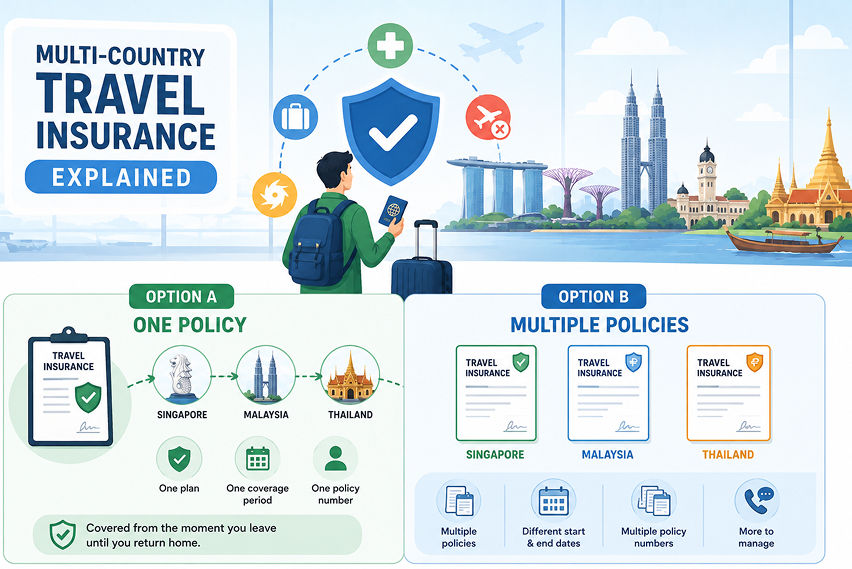
When you travel to just one place, say, a quick beach trip to Bali, you buy a policy for Indonesia, and you’re set. But when you visit Singapore, Malaysia, and Thailand all in one single week, you have two choices on how to protect yourself:
- Option A, one policy: You buy a single travel insurance plan from an insurer and list "Worldwide" or "Asia/ASEAN" as your coverage zone. Now, this single document covers you from the moment you leave the country until the minute you land back home.
- Option B, multiple policies: You buy multiple travel insurance plans for each country on your itinerary. You end up with multiple separate policy numbers, three sets of paperwork, and three distinct start and end dates.
 AI-Generated Image
Also Read: How to claim travel insurance: A step-by-step guide for Pinoy travellers
Option A: The "one policy" approach (all-in-one shield)
For most Filipino travellers, buying a single policy that covers every country on your itinerary is the gold standard. Let’s look at why this option is so popular, along with a few things to watch out for.
The big perks of choosing one policy
- Zero paperwork stress: With a single policy in hand, you carry just one contract, one policy number, and one 24/7 hotline number. Everything is simple, fast, and organised.
- Continuous coverage during transit: What happens if you are sitting in an airport lounge in Vietnam during a layover on your way to Japan, and your bag gets stolen? If you have separate policies, Insurance A might say, "Hey, your trip to Vietnam was over yesterday," while Insurance B says, "We haven't started covering you yet because you haven't touched down in Japan!" A single multi-country policy protects you non-stop while you are high up in the air, hanging out in airport terminals, or riding cross-border trains.
- It saves you hard-earned pesos: Insurance providers charge minimum processing fees for every policy issued. Buying three separate short-term policies almost always costs more than buying a single plan that covers your full 10-day vacation.
The drawbacks of a single policy
While one policy is usually best, it isn't completely perfect in every situation. If you are planning to visit countries with widely varying safety risks or medical costs, your entire policy rate might be based on the most expensive country.
Also Read: Travelling with your aged parents? Don’t skip these travel insurance tips!
Option B: The "multiple policies" approach
Why would anyone want to buy multiple insurance plans for a single trip? While it is rarer, there are specific scenarios when doing so is practical.
When does buying multiple policies make sense?
- Spontaneous side trips: Pinoy travellers love spontaneous adventures! Let’s say you booked a 5-day trip to Hong Kong and bought a basic Hong Kong insurance plan. While having lunch, your travel buddy suddenly says, "Hey, a great destination is just a short ferry ride away! Let's go tomorrow!" Because your original plan only covered Hong Kong, you can quickly buy a separate mini-policy online (via global digital-first providers) to cover your 24-hour side trip. Note: this might be subject to specific waiting periods or conditions.
- Meeting strict visa requirements (like the Schengen area): If you are planning a dream European tour that includes France, Italy, and Spain, you must apply for a Schengen Visa. The embassy requires your travel insurance to have a minimum coverage for medical expenses, issued by an accredited provider. If your main worldwide policy doesn't meet these strict embassy standards, you might need to buy a specific Schengen-compliant policy for Europe, and standard local plans for your other stopovers.
- Long-term travel or backpacking across regions: If you are digital nomading or backpacking to one destination for three months, then heading straight to another destination for another three months, buying localised policies from regional providers as you travel can sometimes offer higher medical coverage at better rates.
Also Read: The biggest travel insurance claim mistakes Filipino travellers make & how to avoid them
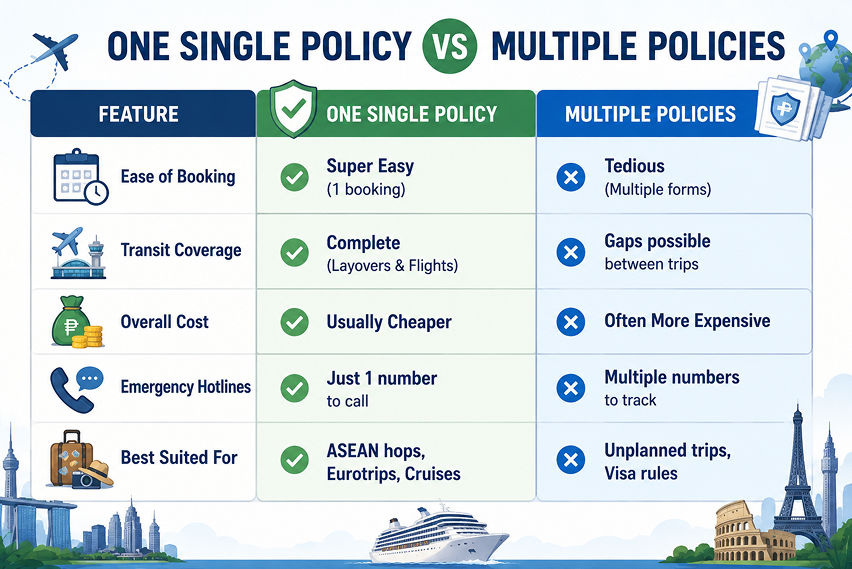
One policy vs. multiple policies: A head-to-head comparison
Helping you visualise the difference between the two clearly, here is a quick breakdown -
 AI-Generated Image
Pro tip: When filling out online travel insurance forms in the Philippines, look for "Worldwide" or regional selection buttons (like "Asia Standard" or "ASEAN Zone"). Selecting these auto-includes all countries in that geographic area!
Also Read: Travel insurance checklist for first-time Filipino travellers
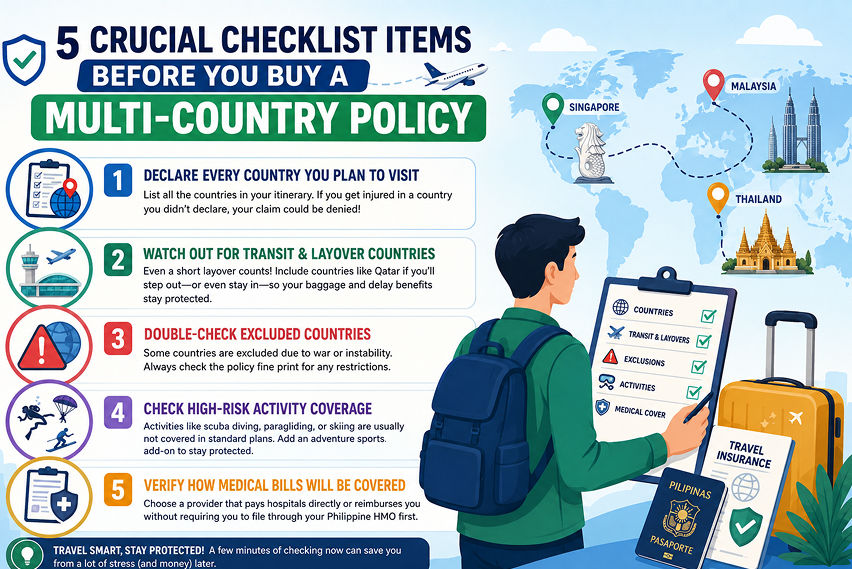
5 crucial checklist items before you buy a multi-country policy
Now that you know which style fits your vacation, don't press that "PAY NOW" button just yet! Make sure you check these five critical details off your list first:
1. Choose the right geographical zones you plan to visit
Most Philippine travel insurers issue policies based on geographic zones (e.g., ASEAN Zone, Asia-Pacific, Worldwide). If a Pinoy traveller buys an "ASEAN Plan," it automatically covers all ASEAN member states (Singapore, Malaysia, Thailand, Vietnam, etc.) under the policy contract.
2. Watch out for transit & layover countries
Having a 12-hour layover in Doha, Qatar on your way to London? If you plan to step outside Doha airport to see the city skyline, make sure Qatar is included in your coverage! Even if you stay inside the airport, having Qatar included ensures your baggage and flight-delay benefits remain active while you wait.
3. Double-check excluded countries
Usually, all insurance companies maintain lists of "sanctioned" or high-risk countries where policy coverage is automatically void. This might be due to active war or extreme instability in a region. It is always recommended to check the fine print of the policy if your multi-stop itinerary includes off-the-beaten-path destinations.
 AI-Generated Image
4. Check high-risk activity coverage
If you are planning to go a bit adventurous with activities like scuba diving, paragliding, or skiing? Note that a standard multi-country travel insurance policy often excludes extreme sports. Here, you may need to get an add-on coverage to your single policy, so you stay protected while chasing adrenaline
5. Verify how medical bills will be covered
A good international travel insurance provider usually covers medical coverage overseas without much fuss. Meaning they either pay directly to the hospital or reimburse you without forcing you to file through your Philippine HMO first.
Also Read: Comparing travel insurance policies: Without looking at price
Bottom line
When planning an epic multi-country vacation, travel insurance shouldn't be a source of confusion. Unless you have an unusually complicated itinerary or sudden last-minute additions, buying ONE single, comprehensive multi-country travel insurance policy is the absolute best way to go.
Also Read: Travel insurance for cruises: Do Filipinos need different coverage?
FAQs
Q1. Can I buy travel insurance if I am already travelling?
Ans. No. Most insurance companies require travellers to purchase your policy before you depart. If you are already abroad, standard travel insurance policies will be invalid.
Q2. Does credit card travel insurance cover multi-country trips?
Ans. Yes, if you bought your round-trip international flight tickets using a premium Philippine credit card that offers complimentary travel insurance. However, you MUST verify whether it covers all intermediate land or sea crossings between countries, as coverage is often strictly tied to airline tickets.
Q3. What happens if I extend my multi-country trip while I am already overseas?
Ans. If you decide to add a 4th country to your trip at the last minute, call or email your insurance provider immediately. Most top Pinoy insurers will allow you to extend your policy period and add extra destinations by paying a small additional premium online.
Q4. Do I need separate insurance for cruise trips with multiple port stops?
Ans. If you are taking a cruise that docks in Singapore, Malaysia, and Thailand, a single multi-country policy is perfect. Just make sure your chosen plan specifically includes a "Cruise Coverage" clause, as medical treatments onboard ships can be extremely costly.
Q5. Does a single policy cover flight delays between third-party countries?
Ans. Yes! A comprehensive multi-country policy protects you across all connecting flights listed in your itinerary—not just your initial flight out of Manila or your final flight back to the Philippines.
Also Read: Lost laptop, camera & phone abroad: Does travel insurance cover electronics?