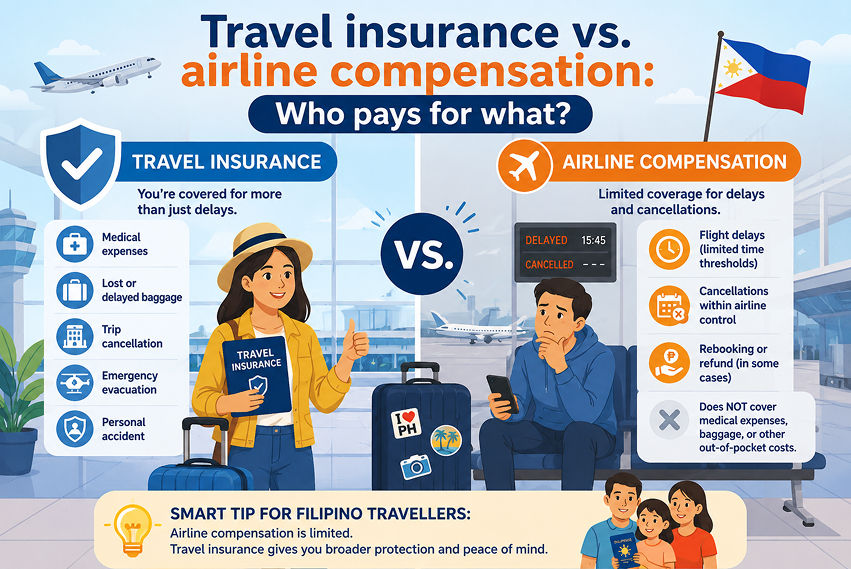





Picture this: You’ve been saving up for months for that dream holiday to Japan to see the autumn leaves, or maybe you finally booked a beach trip to El Nido. Your bags are packed, your outfits are planned, and your excitement is through the roof.
Then, out of nowhere, a sudden typhoon hits Manila, grounding all flights. Or worse, you arrive at your destination, only to find that your luggage, which holds all your carefully curated outfits, has decided to take a solo trip to a completely different country.
A few years ago, we might have just tagged this up as "bad luck". But as we navigate travel in 2026, Filipinos are getting much smarter. We are realising that while we can’t control the weather or airline mishaps, we can protect our wallets from them.
That is exactly where travel insurance comes in. Whether you are flying out of the country or exploring our own beautiful islands, having a safety net is non-negotiable. To help you plan your next adventure with peace of mind, we have answered the most common questions surrounding travel insurance for Filipinos.
Also Read: What is travel insurance, and why every Filipino traveller should understand it
The basics: What exactly are you paying for?
For a long time, many of us viewed travel insurance as just an annoying, extra checkbox when buying airline tickets online. We usually skipped it to save a few hundred pesos. But a standard policy is actually a powerhouse of protection.
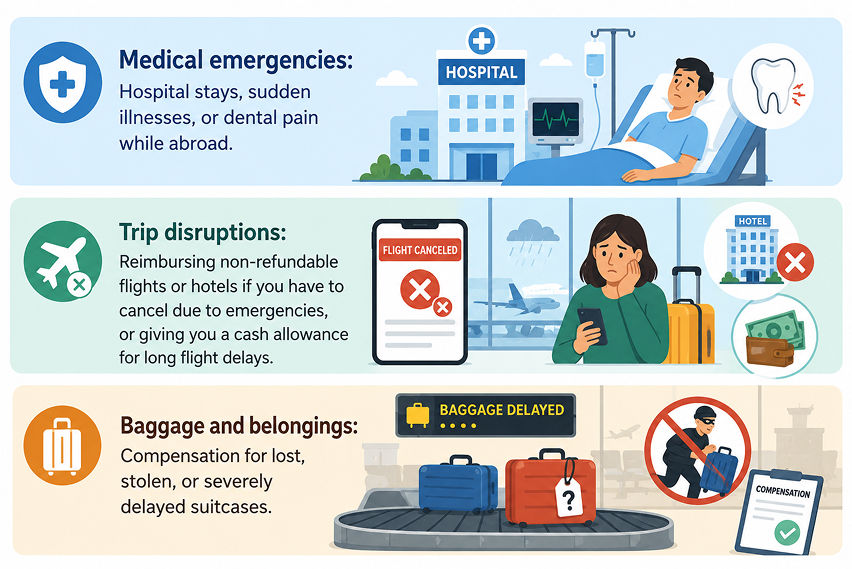
When you purchase a plan, you are paying a small premium so an insurance company can shoulder massive, unexpected costs. Generally, these policies cover three major categories:
 AI-Generated Image
Think of it as your ultimate backup plan. You hope you never have to use it, but if something goes wrong, you’ll be incredibly glad it's there.
Also Read: The cost of flying unprotected: Why travel insurance is your true best friend
Travel insurance FAQs for 2026
To get you up to speed for your 2026 travel plans, here are the exact answers to the most frequently asked questions by Pinoy travellers.
1. Do I really need travel insurance if I’m travelling within the Philippines?
While it is easy to assume that domestic trips don’t need insurance because you are still in the Philippines. But the thing is, local travel carries its own unique set of risks. For instance, our country faces unpredictable weather, and seasonal typhoons frequently disrupt flights and ferry schedules.
If a storm rolls in and you are stuck at the airport, a domestic policy can help cover your meals and emergency hotel stays. Furthermore, if you are visiting remote islands like Siargao or Batanes, local clinics might not have the advanced equipment needed for a major medical emergency. A domestic plan often covers emergency medical evacuation, ensuring you can be safely transported to a major hospital in Manila or Cebu without wiping out your savings.
Also Read: Travel insurance explained: Medical emergencies, flight delays, and lost baggage
2. Is travel insurance mandatory for international trips?
It depends entirely on where you are going. For popular Asian destinations like Japan, Singapore, Hong Kong, or Thailand, immigration officials won’t ask to see an insurance policy. However, it is highly recommended because medical care in places like Tokyo or Singapore can cost hundreds of thousands of pesos for a single hospital night.
On the other hand, if you are travelling to Europe, travel insurance is mandatory. To obtain a Schengen Visa, you must present proof of a policy that covers a set amount of medical expenses and emergency repatriation. In addition, several countries worldwide require insurance as a condition for entry or visa approval.
3. What does "trip cancellation" actually cover? Can I just change my mind?
This is one of the biggest misconceptions. "Trip Cancellation" does not mean you can cancel your flight simply because you don't feel like travelling anymore, or because you had a sudden work scheduling conflict.
Insurance companies only honour trip cancellations for severe, unpredictable, and documentable reasons. Acceptable triggers usually include:
- You, an immediate family member, or your travel companion, is getting dangerously ill or injured right before the trip.
- A natural disaster is making your destination uninhabitable or forcing the airport to shut down.
- A sudden government-mandated travel ban.
If you have to cancel for a covered reason, the policy will reimburse your non-refundable expenses, such as prepaid hotel bookings and tour bookings.
Also Read: Falling ill while travelling? Here's how travel insurance will come to your rescue
4. Will my policy cover extreme activities like scuba diving, hiking, or surfing?
If you are planning an action-packed itinerary, you need to read the fine print very carefully. Standard, off-the-shelf travel insurance policies usually exclude activities that are dangerous/risky/extreme.
If you rent a motorbike in Phuket without a proper license and get into an accident, or if you injure yourself while scuba diving on a standard plan, your claims will likely be denied. In 2026, most local insurance providers offer specialised add-ons for adventure sports. If you plan to go cliff jumping, skydiving, skiing, or deep-sea diving, make sure to check those boxes and pay the small extra fee to ensure your activities are fully protected.
Also Read: Traveller's blueprint: How and when travel insurance pays for emergencies
5. If my flight is delayed, can I immediately claim cash at the airport?
Unfortunately, no. You cannot go straight to an airline counter and demand your insurance payout. Travel inconvenience benefits for flight delays operate on specific time thresholds, usually requiring a delay of at least 6 consecutive hours.
If your flight is delayed by 8 hours, your policy will typically provide a fixed allowance to cover meals or a lounge. To successfully claim this later, you must request an official written statement from the airline. Keep all your original boarding passes, receipts for food you bought during the delay, and communication from the airline. You will submit these documents to your insurer once you return home.
Also Read: Travel insurance requirements by country: Where it's mandatory in 2026
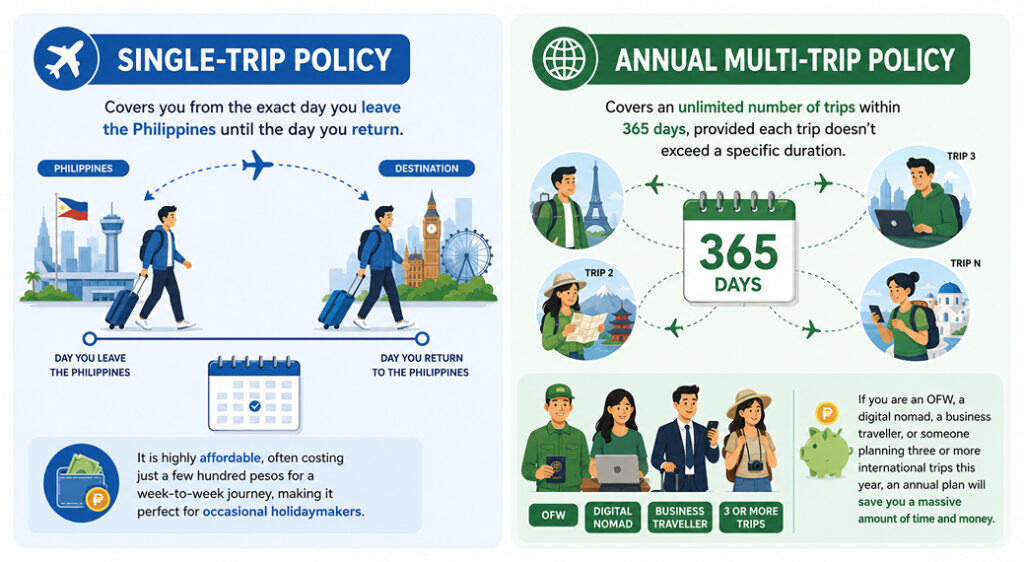
6. How do I choose between a Single-Trip policy and an Annual plan?
Choosing the right structure comes down to math and your travel habits for the year.
 AI-Generated Image
Quick comparison: What to look for in a travel policy
When looking at local providers, don’t just focus on the lowest premium. Use this quick checklist to compare plans effectively:
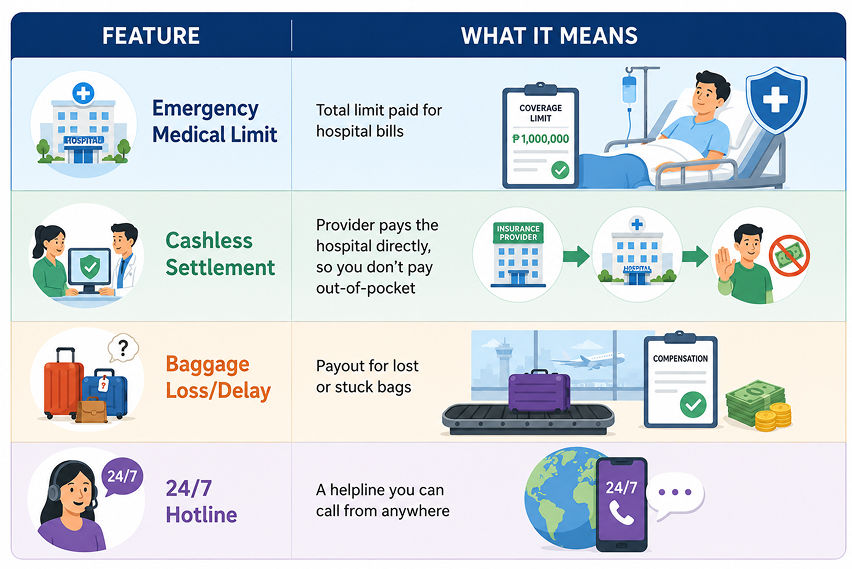 AI-Generated Image
Step-by-Step Guide to Filing Your Claim
1. Notify your insurer immediately: Within 24 to 48 hours.
As soon as an incident occurs (such as getting sick, finding out your luggage is lost, or experiencing a major flight delay), contact your provider’s 24/7 emergency hotline. Even if you don't have all the paperwork yet, informing them creates an official record of the incident.
2. Gather on-the-spot documentation: While at the airport or hospital.
Do not leave the airport, police station, or hospital without official documentation. If your bags are missing, get a report from the airline. If you are sick, get a medical certificate. Insurers will strictly reject claims based only on your word.
3. Download and complete the claim form: Upon returning to the Philippines
Visit your provider’s website to download their specific Travel Claims Form. Fill it out completely and honestly. Most local insurers require you to submit the claim as soon as possible after your return.
4 . Submit the documents and track: Processing takes a few days or even a month
Make sure to hand over a completely filled form, along with all the supporting documents, via email or through their online claims portal. Providers usually process smaller claims in a few working days, while larger claims may take a few weeks.
Also Read: What does travel insurance actually cover in the Philippines?
Required documents checklist
Every claim requires a foundational set of baseline documents, plus specific evidence depending on the nature of your issue.
Basic requirements
- Accomplished travel claim form (signed and filled out).
- Copy of your travel insurance policy/certificate.
- A copy of your original airline ticket and boarding passes.
- Copy of passport’s photocopy and/or a valid government-issued ID
Bottom line
At the end of the day, travelling is all about creating beautiful memories, trying incredible food, and taking a well-deserved break from our busy daily lives. The last thing you want is to return home with massive credit card debt from an unexpected medical emergency abroad or a ruined itinerary.
Buying travel insurance isn't about being paranoid or assuming the worst will happen. It is about being a responsible, mature traveller who respects their own hard-earned money. At a small price, you can secure protection that saves you millions if things go sideways. Before you head out to the airport for your next big adventure, ensure your safety net is securely in place.
Filing a travel insurance claim isn’t that difficult. If you run into trouble while travelling, the secret to getting your claim approved quickly by local providers comes down to two things: acting fast and securing the right paperwork.
The breakdown below covers the step-by-step process and the exact documents required based on what went wrong.
Also Read: Domestic vs. International Travel Insurance: A complete guide for Filipino travelers
FAQs
Q1. Can I buy travel insurance if I am already travelling abroad?
Ans. Standard practice requires you to purchase the policy before your flight leaves Philippine soil. If you buy a policy while already walking down the streets of Bangkok or Tokyo, insurers will consider it invalid.
Q2. Does travel insurance cover pre-existing medical conditions?
Ans. Standard, budget-friendly travel insurance policies strictly exclude pre-existing conditions such as asthma, diabetes, hypertension, or heart complications. If you have a medical episode abroad due to a known condition, a standard claim will be rejected. If you need coverage for this, you must get an add-on with such coverage.
Q3. What should I do if my phone, laptop, or wallet gets stolen while travelling?
Ans. First and foremost, file a report with the local police department and request a physical report. To claim for gadget or cash theft, your policy must specifically include this benefit.
Q4. If I am hospitalised abroad, does the insurance pay the hospital directly, or do I pay first?
Ans. This depends entirely on whether your policy offers cashless settlement and if the hospital is part of your insurer's international network. If it is a major network hospital and you contact your insurer immediately, they can issue a guarantee certificate, allowing the hospital to bill them directly. If you are in a remote area or at a non-network facility, you will usually need to pay the medical bills out of pocket, keep all original receipts, and file a reimbursement claim once you return to the Philippines.
Q5. Are my family members automatically covered under my individual policy?
Ans. No, an individual policy covers only the single person whose name, passport details, and birthdate are printed on the insurance certificate. If you are travelling as a family, everyone needs their own individual coverage. To save money and simplify the process, consider opting for "Family Packages" or "Group Policies".