




Imagine yourself sitting in the driver’s seat, the radio is playing, the AC is at full blast, fighting the afternoon Manila sun, and you are looking forward to having a nice time with your family. Suddenly, the car in front stops abruptly, you apply the brake, but there’s a sudden jolt - scratch & bump! Now, you and your car are involved in a minor accident.
So, what’s next? After checking everyone’s safety, the next thing an adult thinks about is insurance. Yes, in such stressful times, one thing that’ll feel like real support is your insurance provider and the policy.
Car insurance is a financial shield you get by paying a fixed amount to the company, so that if the car is damaged in the future, the same company helps pay the repair bills. But it’s not like the insurer will just hand over the repair money based on a phone call. Rather, an entire process needs to be followed, including a paper trail (i.e., claim documents).
We have curated this guide to help you understand how exactly car insurance claims work. So, put on your reading glasses and read on…
Why does documentation matter?
To avail of the scheme's benefits, you need to follow the steps mentioned above. Similarly, insurers need concrete evidence, proof, to verify that an accident actually happened. It doesn’t end here; they also need to know how it happened, the parties involved, the extent of the vehicle's damage, and the repair cost.
In short, collecting documents helps minimise fraudulent insurance claims.
You see, the requirement to produce certain documents discourages car owners from pretending to be involved in an accident and helps insurers calculate the exact payout.
Do you know that the calculation of insurance payout follows a formula? The amount the insurance company pays is the total cost of fixing the car minus the mandatory fee the owner pays out of pocket.
So, to calculate the payout, the insurer needs to review several documents, and if even a single piece of paperwork goes missing, the entire process will get delayed by weeks, leaving the car stuck in the repair shop.
Also Read: When your car insurance won’t help you - even if you paid on time!
Must have documents for filing a claim
 AI-Generated Image
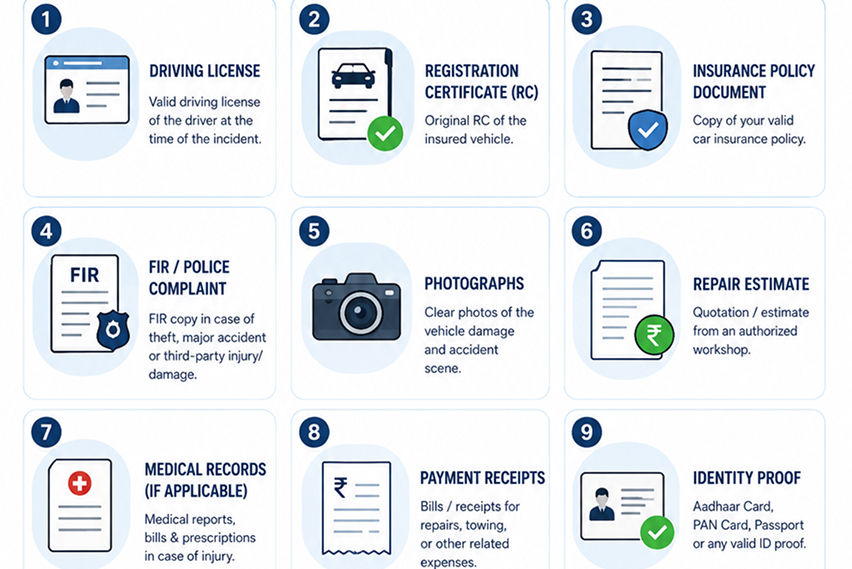
It doesn’t matter if your car scraped a pillar in a tight parking slot or was dented by a delivery motorcycle; there are a few documents that must be presented if you want to claim damages. Below are the four baseline requirements for a standard comprehensive car insurance claim.
Insurance policy
An insurance policy is the very proof of a contract between you and the insurance company. It contains necessary details such as the policy number and coverage information. If possible or required, accompany it with the premium payment receipt, showing the annual fee was paid in time; if not, your claim will be denied immediately.
Driver’s license
You must present the license of the person driving the car at the time of the accident. A valid driver’s license issued by the LTO is a must. Also, sometimes, the providers demand a copy of the LTO official receipt with the license, so carry that as well.
If the driver’s license has expired or the driver holds only a student permit, the claim becomes invalid. It is illegal to drive in the Philippines without a valid license, and insurance companies do not cover illegal acts.
Vehicle’s OR/CR
Every motor vehicle in the country has a Certificate of Registration that contains details such as the vehicle’s chassis number, engine number, and plate number. Along with the CR, you also need to provide the latest registration Official Receipt (OR) from the LTO. This is to prove that the car is legally fit to be on the road.
Photos of the damage & scene
It’s 2026, and smartphones are the ultimate tool for insurance claims. Immediately after the accident and ensuring everyone's safety, the driver must start clicking pictures. Of what? The list includes
- Close-up shots of the damage, such as scratches or dents
- Wide-angle shots of the car's position on the street
- License plates of all involved parties (to prevent future disputes)
Also Read: The Philippines Insurance Commission: Ways in which it protects car owners
Documenting the accident
Now that the basic documents are in place, it's time to figure out a way to prove what actually happened on the road. A policyholder has two options for documenting the incident: a police report or a notarised affidavit. It is not like you can pick anyone as per your convenience; in fact, the choice depends on the complexity of the accident.
For example, if the accident involves another person being injured or a non-cooperative driver, a police report is the only option. Let us discuss the two choices in detail -
Police Report
It is an official document by a traffic investigator. You see, whenever an accident occurs on a major highway, police officers will arrive. Upon arrival, they will meet with the involved parties and prepare an official report detailing the incident. It usually takes a few days to pick up the official, stamped copy of the police report from the local authorities.
Notarised affidavit
Say you were reversing your car and it hits a pole or scrapes a curb while turning into a narrow street. Here, no second car or third party is involved, and no police officials arrive at the scene. In such cases, a police report is unnecessary; instead, a notarised affidavit of the accident will suffice.
|
What is an affidavit? It is a written statement in which a person swears, under oath, that what is stated in the document is absolutely true. What information does it include? It mentions the exact time and location of the accident, along with how the incident unfolded. |
Note that an affidavit by itself is not legally accepted; for that, you must get it to a lawyer called a Notary Public. It is only after the Notary signs and seals the affidavit that the insurance company assigns a value to it.
| Where to find a notary's office? You can find small notary offices near city halls and government offices. |
Also Read: Personal Accident Coverage for riders in the Philippines: Why it matters
Special document requirements for unfortunate situations
The documentation requirement we discussed above is fine for minor fender benders. But when the worst happens, like a car theft or flooding, the insurance company will require additional paperwork to process the claim.
Documentation in case of car theft
A police report is not enough when your car is towed from a parking spot. Here, the owner must visit the Philippines National Police Highway Patrol Group (PNP-HPG). This unit specialises in car-related crimes and will issue official documents after a certain period, proving that the search for the stolen car was unsuccessful. It is only after you receive the non-recovery certificate from the PNP-HPG that your provider will pay out the value of your lost car.
Documentation in case of a natural disaster
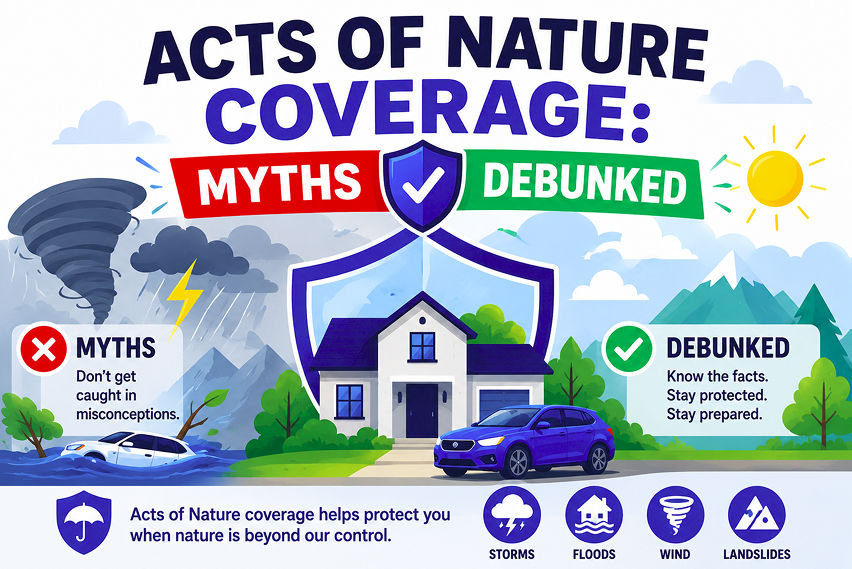
We are frequently visited by typhoons, often powerful ones that bring heavy rain and severe flooding. If your car insurance policy includes Acts of God coverage, it will pay for damage caused by floods, volcanic ashfalls, or earthquakes.
However, to claim this, you need to provide the following to your insurer: an official weather report for the day of the incident and a newspaper clipping of the incident. Also, a video clip showing the car submerged or damaged by a natural disaster is highly recommended.
Also Read: Must-have add-ons for 2026: What you shouldn’t miss
Insurance claim requirement & digital shift
In 2026, many insurance providers will allow policyholders to upload all the required documents via a mobile app or web portal. So, less physical printing and fewer headaches.
Also Read: Car insurance expired? Act fast before you drive again in 2026
Glove box checklist
It is incredibly smart to keep a small, waterproof folder in your car’s glove compartment that contains essential photocopies. Here’s a quick checklist -
- Photocopy of the car’s Certificate of Registration
- Photocopy of the current LTO Official Receipt (OR)
- A photocopy of the driver’s license
- Insurance policy number and emergency hotline number of the insurer
Also Read: Got a new high-end car? Here is the best insurance guide (for 2026)
Bottom line
Car accidents may feel overwhelming, but if you clearly understand the paperwork, the chaos is minimised, and everything becomes organised. So, with vehicle documents completed, a clear police report or a notarised affidavit, and accurate repair estimates, you’ll be able to navigate the insurance process swiftly. Thus, fetching you the much-needed financial help.
Also Read: Fake car insurance: How to verify your provider
FAQs
Q1. What if we lose the original copy of the car’s CR?
Ans. Insurance providers do not process a major claim without a valid CR. So, if the original CR is lost, you must file an Affidavit of Loss and visit the LTO office.
Q2. Can I still file a claim if the accident took place outside Manila?
Ans. Yes. Standard comprehensive car insurance policies cover the insured vehicle anywhere in the Philippines. However, it is recommended to gather documents locally where the accident occurred, like a police report.
Q3. Do I need to submit documents to the insurer right away?
Ans. It is recommended that you submit the basic documents immediately, such as a driver’s license, a police report, and photos. For specific requirements, insurers usually grant some extra time.
Q4. What is a deductible or participation fee?
Ans. A deductible is the fixed amount that policyholders must pay out of pocket for repairs before the provider covers the remaining balance.
Q5. The accident was not my fault. Do I still need to submit all the paperwork?
Ans. Yes. Your provider needs the paperwork to prove the other driver’s fault. Make sure to provide a clear police report detailing the other party's fault - this allows the insurer to pay you for the repairs immediately and, thereafter, pursue the at-fault party’s provider to recover the money.
Also Read: 9 shocking total loss coverage myths every car owner should stop believing