




While buying a car or insurance for its protection, one thing that remains common is seeking advice from friends and family. And in this age of digitisation, scrolling through Pinoy car groups on Facebook or browsing local automotive forums in search of answers is pretty common too. However, it is not as helpful as it may sound. The sheer volume of conflicting advice you get online is mind-boggling.
For a car owner planning an important insurance decision, such experience will not only be exhausting but, honestly, incredibly dangerous to the wallet.
It's only when the typhoon hits, and the roads turn into rivers, that car owners find out the hard way that social media comments make terrible insurance advisors. Thus proving that misinformation spreads quickly, and when it does, it leads to consequences—in this case, rejected claims, massive repair bills, and broken trust.
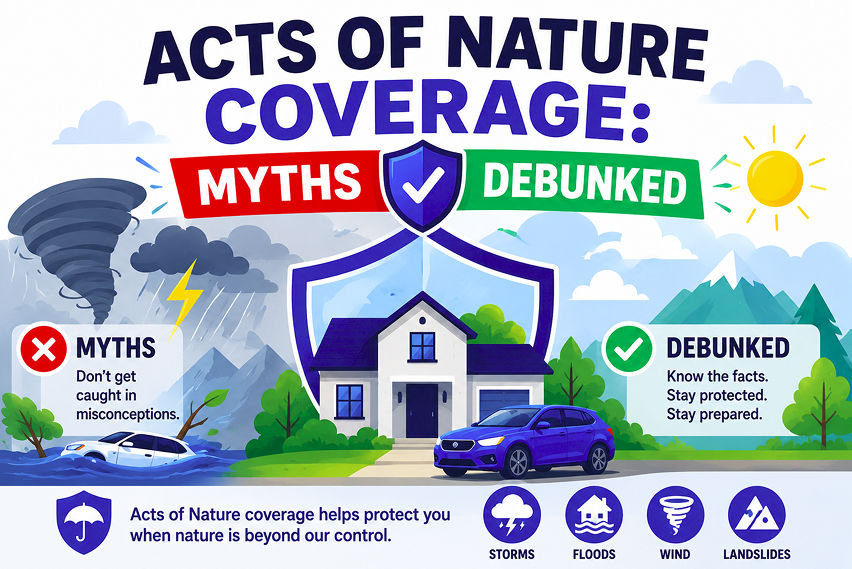
It is time to clear the air and look at how the local insurance industry actually operates. Here are the most common myths about Acts of Nature (AON) coverage, completely debunked by reality.
Also Read: Car Insurance 101 for New Drivers in 2026: Basics you can’t skip
Myth 1: I have a comprehensive policy, so floods are automatically covered
This one is the biggest and the most expensive trap in the local insurance market. Every year, thousands of car owners get caught off guard by it.
The word, comprehensive sounds total - like it wraps your car in a protective bubble wrap, protecting it against absolutely everything that the universe throws at it. In fact, the literal definition of comprehensive is complete.
However, when it comes to insurance, ‘Comprehensive’ has a very specific, limited definition. Typically, a comprehensive car insurance policy covers own damage from collision, accident, theft, fire, and malicious damage by third parties. Sometimes, there is even legal liability for property damage or bodily injury to others.
Acts of Nature coverage is almost always an add-on; a separate line item in itself. Meaning, if you don’t explicitly check the AON box and pay the extra premium for it, your comprehensive policy won't do a single thing when your car gets hit by a natural disaster.
Suggestion: When you buy an insurance policy - online, bank, or agent - make sure to read the inclusions in your policy. In case you don’t see Acts of Nature or Acts of God listed with a specific premium amount next to it, you are playing a massive financial gamble.
Also Read: Roadside assistance for motorcycles 101: Ultimate guide for Filipino riders
Myth 2: If it’s a government-declared state of calamity, insurers must waive the deductible
While it may sound fair on paper, when the city is submerged, local government units step in, and everyone is struggling to get their lives back together, the insurance company will waive the participation fee. Or some consumer protection law will force them to do so.
But the reality is harsh. Insurance companies don’t do so.
When a local or national government declares a state of calamity, a very specific local mechanism gets triggered. This leads to freezing the prices of necessities, preventing hoarding, and enabling access to emergency relief funds. All this does not alter, cancel, or rewrite private, legally binding contracts between you and your provider.
So, the deductible/participation fee you agreed to pay from your pocket before the insurance payout kicks in to cover the rest of the repair costs stays the same. So, whether it is a regular rainy afternoon or a super typhoon making international headlines, you’ll have to pay a fixed amount to get your claim processed.
Also Read: Car broke down? Here’s how towing can rescue you fast
Myth 3: AON coverage includes my new aftermarket and custom setup
 AI-Generated Image
We know the drill - spending weeks researching the perfect look for your ride, saving money for a gorgeous set of imported wheels, a high-end sound system, and even a sleek body kit. And then, in a split second, just like that, everything is gone, all thanks to the flash flood that hit your garage and ruined it all.
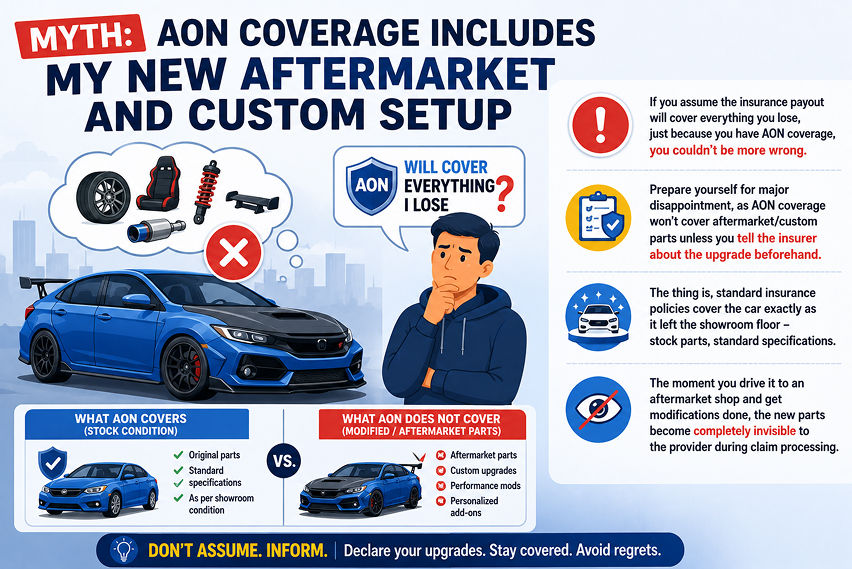
Now, if you assume the insurance payout will cover everything you lose, just because you have AON coverage, you couldn’t be more wrong.
Prepare yourself for major disappointment, as AON coverage won’t cover aftermarket/custom parts unless you tell the insurer about the upgrade beforehand.
The thing is, standard insurance policies cover the car exactly as it left the showroom floor - stock parts, standard specifications. The moment you drive it to an aftermarket shop and get modifications done, the new parts become completely invisible to the provider during claim processing.
If you want your modifications protected, you need to declare them as ‘accessories’ with the provider.
Also Read: Top reasons to choose car insurance with total loss coverage
Myth 4: If a tree falls on the car during a storm, it’s not covered by AON as the tree belongs to someone else
People get into massive, prolonged feuds with their neighbours over such a scenario. A storm rips a massive mango tree next door, crashes over the fence, and falls onto your hood. Suddenly, the friendly conversation ends, and the discussion turns to who will pay the repair bills.
In such a situation, the insurance adjuster will look for the root cause of the incident - that’s what matters the most.
So, if the tree falls due to an unpredictable wind or a storm, it is classified as an Act of Nature event. And your AON add-on will handle it. All you need to do is file the claim with your insurer, pay the participation fee, and get the car fixed.
However, your insurer might look into whether the falling of the tree was grossly negligent. For instance, the tree had been dead, rotting, or leaning dangerously for months, and you have documented proof that you assured them you would cut it down before the storm. In such cases, you don’t have to wait for the dispute to settle in court; instead, your policy will step in first to take care of you. Should the investigation prove that your neighbour was grossly negligent, your insurance provider might initiate a subrogation claim against your neighbour's company to recover the repair costs.
Also Read: Is your current insurance provider still worth it in 2026? Here’s how to tell
Myth 5: I have AON coverage, so it doesn’t matter if I drive through a deep puddle
We’ve all seen those viral videos during the rainy season. Wherein there is a flooded underpass, a long line of hesitant drivers waiting for the water level to decrease, and that one guy in a mid-sized SUV or a pickup truck who thinks his vehicle is nothing less than a naval destroyer. He goes into the water, creates a massive wake, stalls halfway through, and destroys his engine.
Insurance exists to protect you against sudden, accidental, and completely unavoidable losses. It is not a safety net for willful recklessness. If the insurance adjuster reviews the CCTV footage or looks at the onboard dashcam and sees that you looked at a deeply flooded road, had the opportunity to turn around or wait it out, but chose to force your way through anyway, they can—and will—deny your claim.
AON is designed for when the water rises around your properly parked car, or when a sudden flash flood traps you on the highway without warning. It is absolutely not an invitation to test your car's wading depth.
Also Read: Engine protection in car insurance: What Philippine car owners should know
Myth 6: I can just add Acts of Nature coverage to my policy when the typhoon enters the Philippines Area of Responsibility (PAR)
 AI-Generated Image
The weather forecast on the news says a massive typhoon has just entered the Philippine Area of Responsibility (PAR) and is tracking straight toward your province. You panic, pull out your policy, realise you skipped the AON rider to save money, and immediately call your insurance agent to add it.
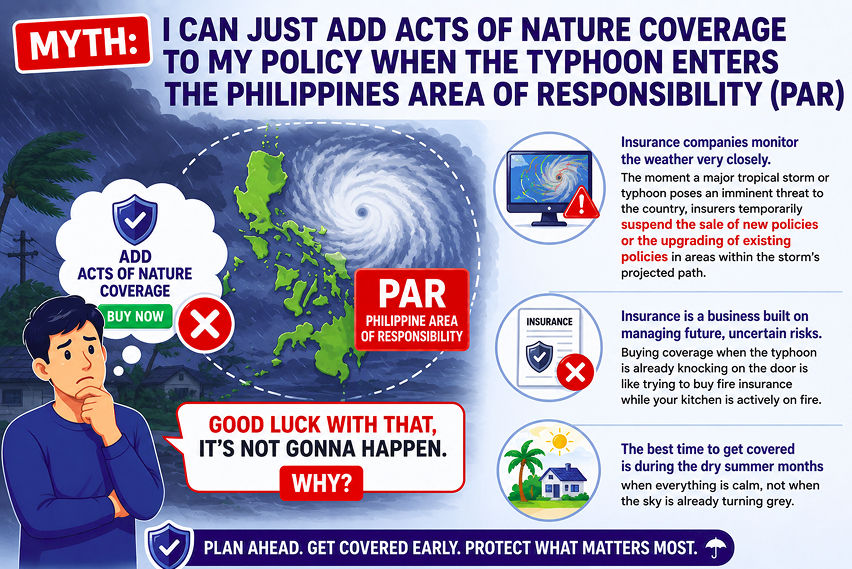
Good luck with that, it’s not gonna happen. Why?
Insurance companies monitor the weather very closely. The moment a major tropical storm or typhoon poses an imminent threat to the country, insurers temporarily suspend the sale of new policies or the upgrading of existing policies in areas within the storm's projected path.
Insurance is a business built on managing future, uncertain risks. Buying coverage when the typhoon is already knocking on the door is like trying to buy fire insurance while your kitchen is actively on fire. The best time to get covered is during the dry summer months when everything is calm, not when the sky is already turning grey.
Also Read: Is SRCC add-on car insurance worth it for Filipino car owners in 2026?
Bottom line
Navigating car ownership in the Philippines means accepting that nothing, including the weather, is completely under your control. As the city drainage system isn’t getting fixed itself, rainy seasons aren’t getting milder, and the typhoons aren’t getting any weaker.
Never let unverified comments on Facebook groups and insurance forums dictate your insurance decisions. We’d advise you to take five minutes today and pull out your insurance policy. Read the fine print thoroughly, including the coverage breakdown. It’ll help you know what you are paying for before the grey clouds roll in, because once they are over your head, it’ll be too late to change anything for good.
Also Read: 9 shocking total loss coverage myths every car owner should stop believing
FAQs
Q1. Does the Acts of Nature coverage have a limit, or will it pay my car’s full value?
Ans. Acts of Nature coverage is linked to the insured vehicle’s ‘Fair Market Value’. It does not offer unlimited money. If your car is declared a total loss, the insurer will pay the total insured amount minus the deductible.
Q2. Can I file an AON claim if a lightning-caused fire damages my car?
Ans. Yes. Lightning is a natural event that cannot be controlled or predicted. If a direct lightning strike causes a fire that damages your car, it falls under the AON scope.
Q3. What should I do if my car gets flooded to ensure approval of the AON claim?
Ans. Do not start the engine; it may cause the water to enter the cylinders and crack the engine block. In this case, the claim will be denied because you caused the mechanical damage yourself. What you should do instead is take clear pictures of the damage, the car's parking location, and the water level. Call for roadside assistance and notify the insurer.
Q4. Does AON coverage cover hailstorm or extreme weather damage?
Ans. Yes. While hailstorms are rare in the Philippines, they are occasionally reported in high-altitude regions. As they are weather phenomena, any damage to the car’s body or cracks in the windows caused by them are covered under the AON add-on.
Also Read: 2026 guide for car insurance claim documents - A must-read